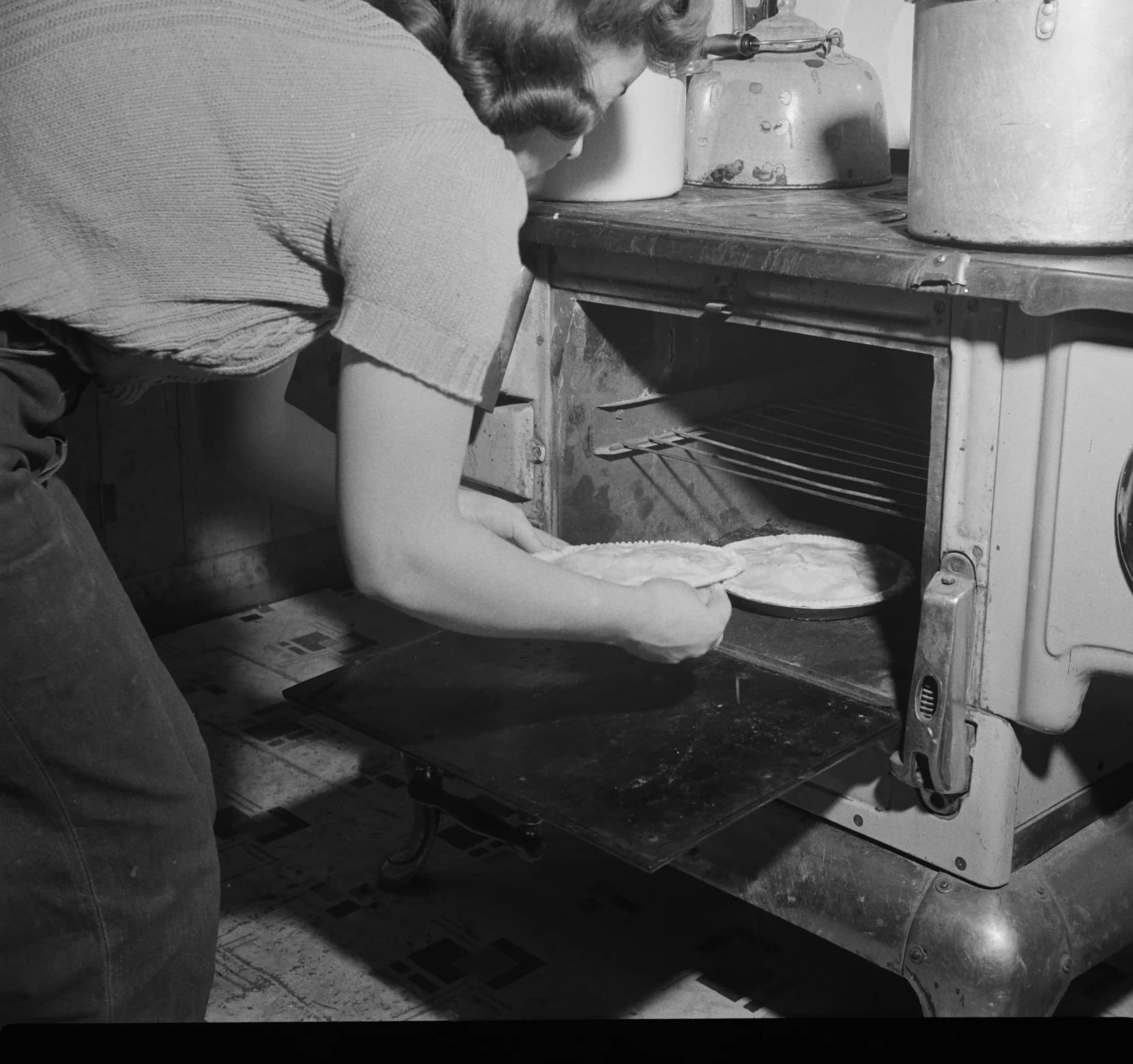
Apple pie came to America from England and the Low Countries, and the domestic apple came from Central Asia by way of Europe. The pie became an American emblem only in the late 19th and 20th centuries. The phrase “as American as apple pie” has several claimed first appearances, from 1910 to 1924.
The oldest English apple recipe that resembles a pie is older than the Atlantic crossing. A manuscript dated 30 August 1381, published by Samuel Pegge in 1780 with the Forme of Cury, gives “For to make tartys in applis.” It opens: “Tak gode Applys and gode Spycis and Figys and reysons and Perys.” Popular accounts often credit the recipe to the Forme of Cury itself, compiled about 1390; Salon names Pegge as its author, though he was its 18th-century editor.
The Dutch had theirs too. Een notabel boecxken van cokeryen, printed in Brussels around 1514 and the first cookbook printed in Dutch, gives “Appeltaerten”: apples peeled and cut small, the shell filled to the top, covered with a lid of dough and baked.
The fruit was also a newcomer. The USDA’s Agricultural Research Service describes Central Asia, Kazakhstan and Kyrgyzstan in particular, as the likely ancestral home of the domestic apple. The USDA PLANTS database lists the sweet crab apple, Malus coronaria, as native to the United States, and the cultivated paradise apple, Malus pumila, as introduced. Mental Floss and Salon both state that crab apples were the only apples in North America before European settlement.
Simmons’s American Cookery of 1796 gives two apple pies. By 1882 an English traveler, Walter Gore Marshall, could report that Americans ate apple pie all over the country, flat rather than raised, and often with cheese. In 1913 Henry T. Finck conceded the pie’s English ancestry and still claimed it as American “by right of conquest, improvement” and national reach, according to Barry Popik’s citations.
The phrase is harder to date. Popik cites an October 1910 theater review in Metropolitan Magazine calling a play “as American as apple pie.” Pascal Tréguer’s earliest example is from the Sun and New York Herald of 4 April 1920, about the Kaiser’s borrowing of “ideas as American as apple pie” from the circus. Salon gives a 1924 Gettysburg Times advertisement for suits as an early example, and Salon and Mental Floss both cite a 1928 New York Times description of Lou Henry Hoover.
War fixed the symbol. Popik writes that the phrase took off in the early 1940s, and Salon and Mental Floss report that American soldiers in the Second World War said they were fighting for “mom and apple pie.” Mental Floss and Salon also point to a 1926 New York Times headline about American tourists in Europe, “The Tourist Apple Pie Hunt Is Ended,” which called the travelers an “American Army Abroad” that had again failed to find pie like the kind made at home. Mental Floss suggests the Times helped create the idea that the pie was an American invention.