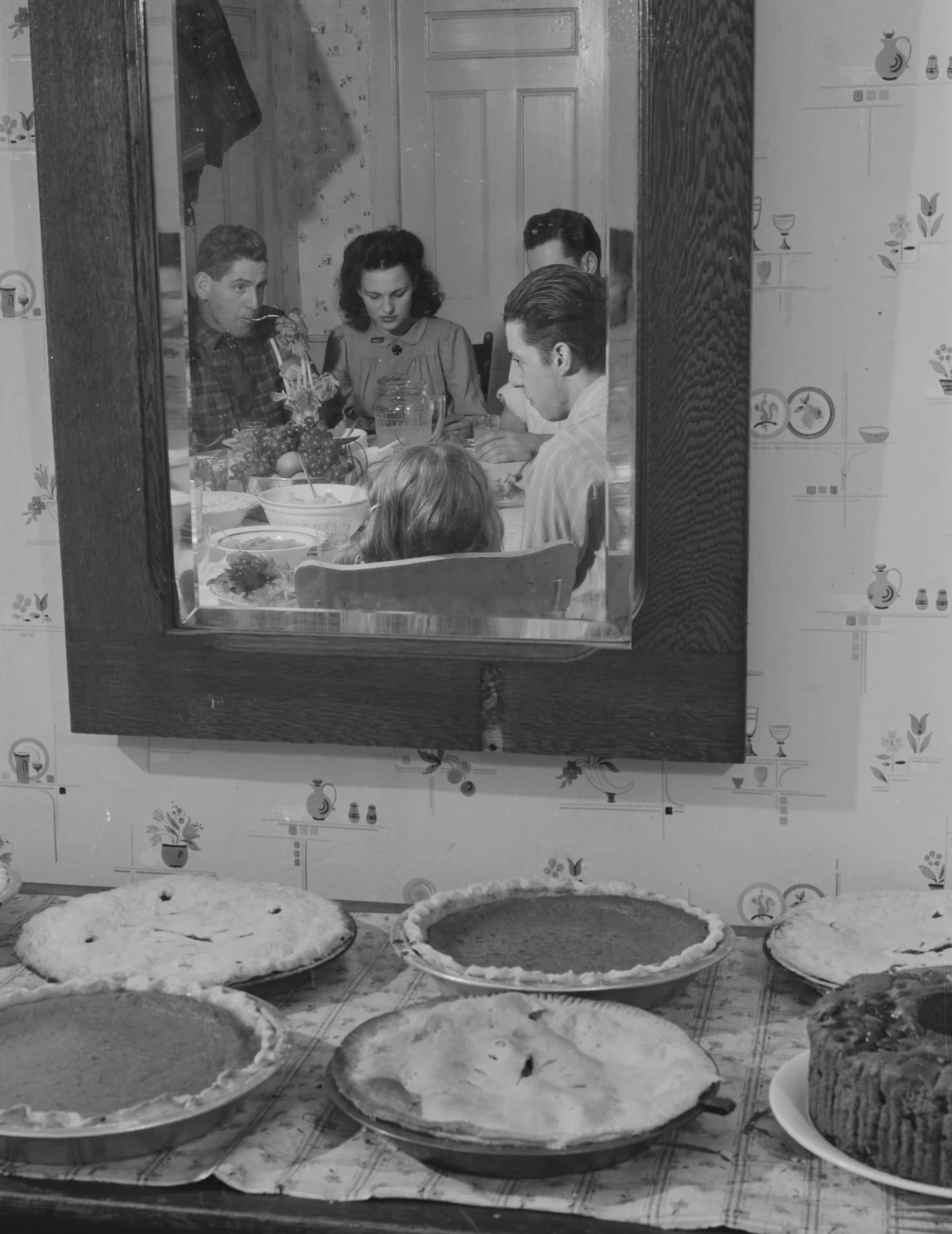
The two pies are close cousins, both spiced custards in a crust, but they arrive at the holiday table by different roads. Pumpkin pie was tied to New England and the Thanksgiving story; sweet potato pie became a pillar of Southern and African American cooking. Historians agree the split is real and that it is less tidy than a line between regions or races.
Both pies appear in the first American cookbook. Amelia Simmons’s American Cookery of 1796 gives two recipes headed “Pompkin” among her puddings: stewed and strained pumpkin with cream, eggs, sugar, mace, nutmeg and ginger, laid into paste and baked; and a plainer version with milk, molasses, allspice and ginger in a crust. Under her squash pudding she adds that the same recipe is good for “Pompkins, Potatoes or Yams.”
The pumpkin pie’s place at Thanksgiving owes much to Sarah Josepha Hale. Her 1827 novel Northwood described a Yankee Thanksgiving with pumpkin pie as an indispensable part of it, and in 1863 she persuaded President Lincoln to proclaim a national day of thanks, according to NPR and CNN. The historian Debra Freeman told CNN that Southern resistance to what it saw as a Northern holiday made pumpkin pie a symbol of Northern ideals. CNN notes the holiday did not become a fixed national holiday until 1941.
Sweet potato pie took a Southern road. The soul food historian Adrian Miller told NPR that colonists may first have used sweet potatoes as a stand-in for carrot pie, that enslaved African cooks prepared them in the European pie form for slaveholders, and that the vegetable may have recalled West African yams. CNN, citing Miller’s book Soul Food, adds that George Washington Carver circulated a double-crust sweet potato pie recipe in his agricultural bulletin in the 1930s. Carver’s Tuskegee Bulletin No. 38, How the Farmer Can Save His Sweet Potatoes, survives in a copy dated February 1922 and in a third edition of November 1935. Both print a mashed sweet potato pie baked “with bottom crust only” and a sliced sweet potato pie closed with an upper crust and crimped.
Canning settled the pumpkin side for most households. The Christian Science Monitor reported in 1990 that Libby had canned pumpkin in Morton, Illinois, since 1929, when it bought the Dickinson canning plant and exclusive rights to the Dickinson pumpkin variety. By then, the paper wrote, just about all Thanksgiving cooks used canned pumpkin, and Libby claimed more than 90 percent of the market.
The historians quoted on this question resist a simple map. The food scholar KC Hysmith told CNN that neither vegetable is native to the United States in particular, and that both pies descend from English pie-making and the spice trade. The culinary historian Michael Twitty told CNN his family grows its own sweet potatoes for pie, a tradition he traces to at least the 18th century, and never served pumpkin. Miller put his own household’s position to NPR plainly: “So it’s always sweet potato pie.”