Fruits · apple
Baldwin
Firm, juicy and agreeably subacid, in Beach’s 1905 description.
3 of 5 from sweet (1) to very tart (5). Rated from Beach’s 1905 description of the flesh as “agreeably subacid, sprightly, somewhat aromatic.”
- Origin
- Wilmington, Massachusetts, in the eighteenth century. Beach (1905) says it came up as a chance seedling soon after 1740 on the farm of John Ball, which later passed to a Mr. Butters. The Wilmington Memorial Library says most versions agree that William Butters found or planted the tree on his property in the eighteenth century. Both name Loammi Baldwin of Woburn as the man who propagated and promoted it; Beach dates his introduction of it in eastern Massachusetts to as early as 1784.
- Season
- A winter apple, picked after Rhode Island Greening in New York; in ordinary storage, in season from November to March or April (Beach, 1905).
- In the oven
- Firm and juicy. Beach (1905) judged it “well adapted for general market, dessert and culinary uses,” though he ranked Rhode Island Greening decidedly superior for cooking. Fruit unsuited to barrels supplied much of New York’s evaporator stock and some canneries. No modern test-kitchen account of how it bakes has been found.
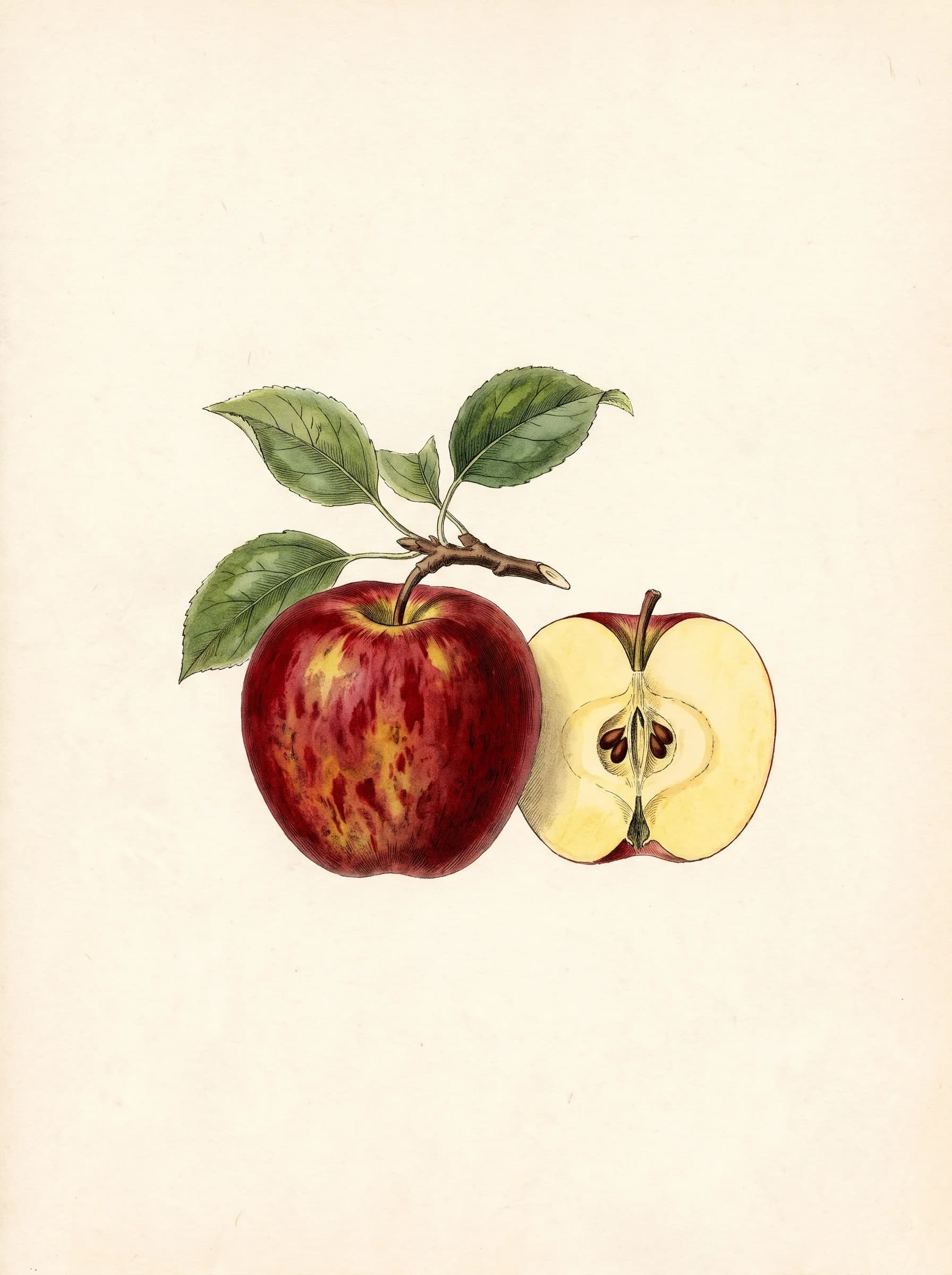
The Baldwin is a red winter apple from eighteenth-century Massachusetts, named for the engineer Loammi Baldwin. By 1852 it was the most popular apple of New England, and in 1905 it led commercial orchards in New York and New England. A monument marks the site of the original tree.
Beach’s history gives the tree’s early names: Woodpecker or Pecker, for the birds that frequented it, and Butters, for the family that came to own the farm. Deacon Samuel Thompson, a surveyor of Woburn, brought it to Colonel Loammi Baldwin, who propagated it and gave it his name. Beach says the original tree was alive in 1817 and died between 1817 and 1832. The Wilmington Memorial Library says it is said to have blown down in a storm in the early nineteenth century. A monument stands on Chestnut Street in Wilmington, next to the William Butters II farmhouse.
Hovey wrote in 1852 that the Baldwin was the most popular apple of New England, with orchards near Boston producing about a thousand barrels each bearing year, and fifteen hundred barrels sent to the East Indies in one season. Beach called it preeminently the leading commercial variety in New York, New England, southern Canada, southern Michigan and northern Ohio. He also recorded its faults: biennial bearing, winter-killing in the colder parts of New York, scab, and the physiological defect known as Baldwin Spot.
Its thick skin and firm flesh let it stand handling, cold storage and export, by Beach’s account. Beach rated it good for culinary use but placed it below Rhode Island Greening for cooking. The Baldwin was one of four apples on a 2013 United States postage issue, with Golden Delicious, Northern Spy and Granny Smith, according to e-WV.