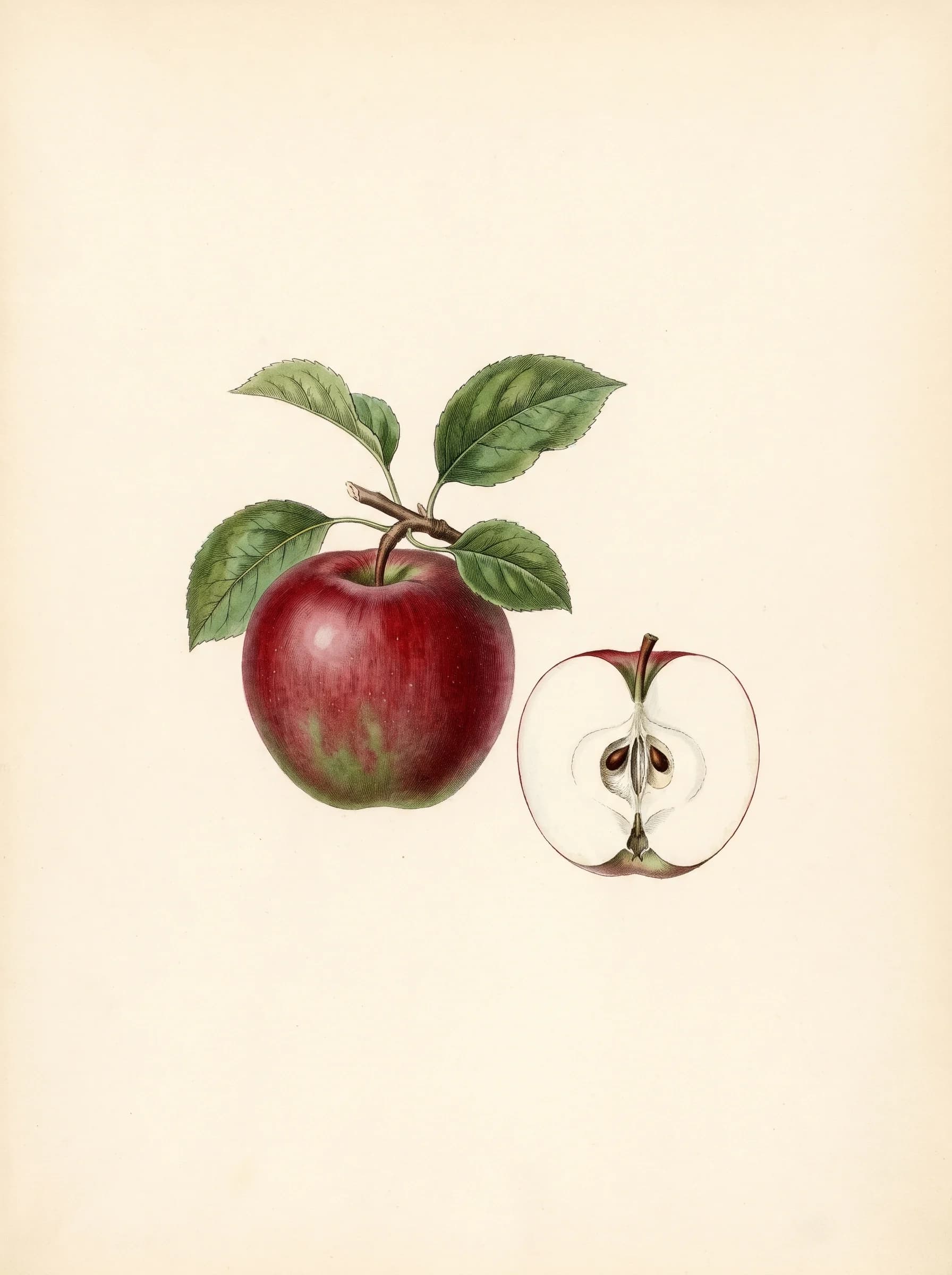
Fruits · apple
McIntosh
Juicy, tangy and aromatic, in the New York Apple Association’s description.
3 of 5 from sweet (1) to very tart (5). Rated from the New York Apple Association’s profile, “sweet, with a tart tang,” and The Canadian Encyclopedia’s “crisp and tart tasting” flesh.
- Origin
- Dundela, Dundas County, Upper Canada (now Ontario), as a chance seedling found by John McIntosh in 1811, according to The Canadian Encyclopedia and the New York Apple Association. Accounts of its spread differ: The Canadian Encyclopedia says John’s son Allan was growing and selling trees by 1835 and that it entered commercial production as “McIntosh Red” in 1870; Beach (1905) says Allan McIntosh began propagating it in the nursery about 1870.
- Season
- Ripens at about the same time as Cortland, whose average ripening date at Geneva, New York, is October 7 (Way and Brown, 1997); because McIntosh drops from the tree, growers tend to pick it first. The New York Apple Association lists New York fruit as available September through June.
- In the oven
- Breaks down. The New York Apple Association advises that its tender flesh “cooks down quickly” and that a pie needs a thickener. In King Arthur Baking’s test its texture was “extremely soft; slices turned to chunky applesauce.”
McIntosh is a red and green apple found in Upper Canada in 1811 and often called the national apple of Canada. It is tender, juicy and aromatic, and grows best in cool climates. In pie it cooks down quickly, and the New York Apple Association advises a thickener.
The Canadian Encyclopedia records that John McIntosh found the original tree in 1811 in an overgrown part of his orchard at Dundela. His son Allan is credited with grafting it onto hardy roots, and by 1900, with the praise of the Dominion Horticulturist W. T. Macoun, it was one of the most popular apples in northeastern North America. The original tree died in 1906 after fire damage. The last known tree grafted from it died in 2011, and a clone grows at Upper Canada Village near Morrisburg, Ontario.
Beach (1905) described the flesh as white, very juicy, perfumed and sprightly subacid, “becoming mild and nearly sweet when very ripe.” The variety does best in cool regions; the New York Apple Association says it grows particularly well in New York’s climate. In 2017, 21 percent of the apples produced in Ontario were McIntosh, by The Canadian Encyclopedia’s figures. It is a parent of Cortland and of Empire, among others.
Its tenderness defines its use in pie. The New York Apple Association rates it good for pies and advises a thickener, because the flesh cooks down quickly. King Arthur Baking’s tester found McIntosh slices turned to chunky applesauce as soon as they were touched, with a taste very similar to Cortland’s.
Sources
- McIntosh Apple, The Canadian Encyclopedia
- The Apples of New York, vol. 2 (S. A. Beach, New York Agricultural Experiment Station, 1905), Internet Archive
- McIntosh, New York Apple Association
- The best apples for apple pie: Here’s how to choose (PJ Hamel, King Arthur Baking)
- ‘Cortland’ Apple (Roger D. Way and Susan K. Brown, Fruit Varieties Journal 51(2), 1997)
- Heirloom apples are ripe for the picking, University of Missouri Extension (2021)