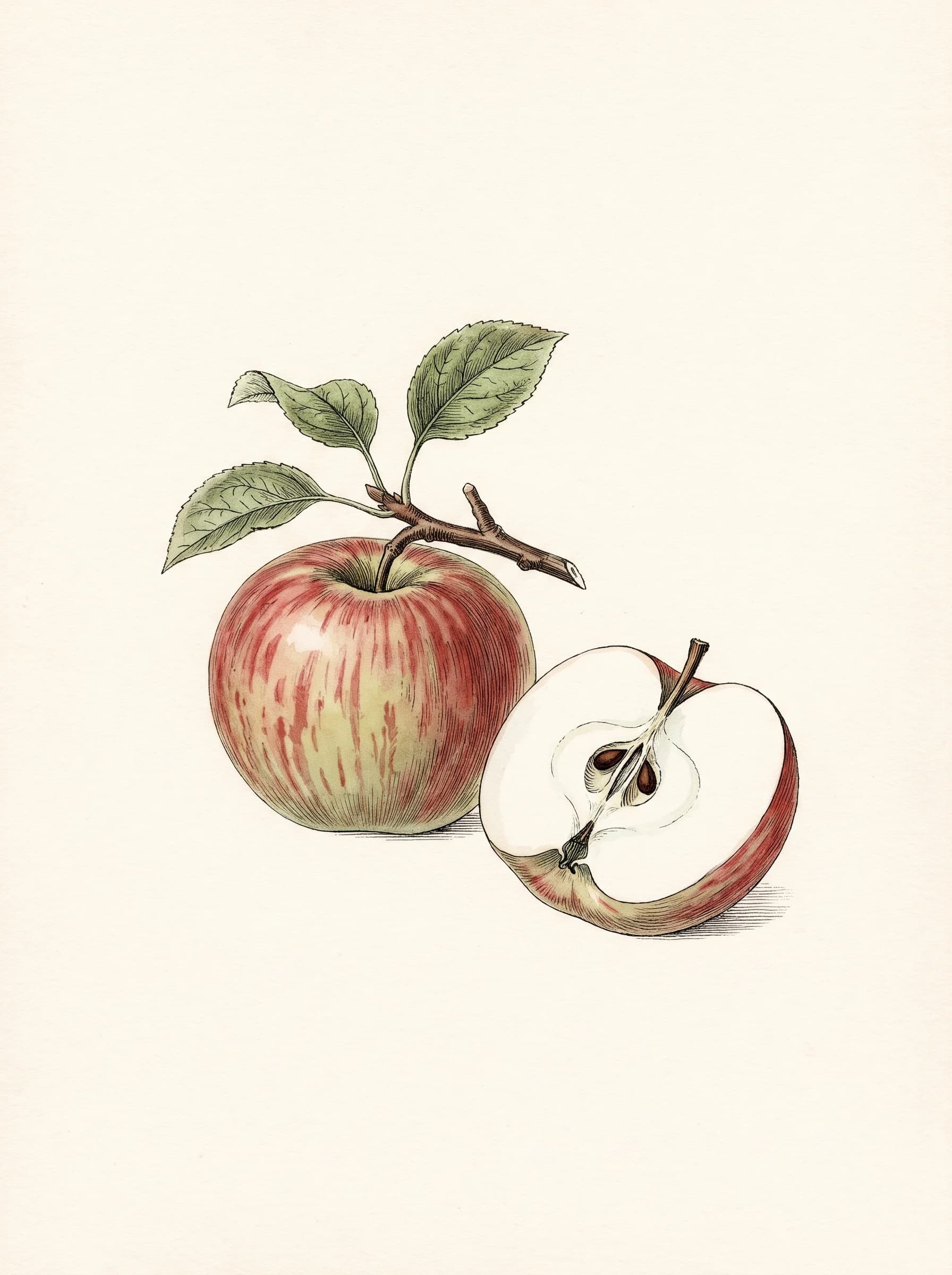
Fruits · apple
Cortland
Sweet with a hint of tartness, juicy and snow-white, in the New York Apple Association’s description.
2 of 5 from sweet (1) to very tart (5). Rated from the New York Apple Association’s profile, “sweet, with a hint of tartness”; King Arthur’s baked test found “a nice balance of sweetness and tang.”
- Origin
- New York State Agricultural Experiment Station, Geneva, New York. Way and Brown (1997) record that S. A. Beach made the cross Ben Davis × McIntosh in 1898, that Cortland was selected in 1911 from 11 seedlings, and that it was introduced in 1915. The New York Apple Association gives 1898 as the year it was developed.
- Season
- Geneva, New York: average ripening date October 7, three days before Delicious, with 142 days from full bloom to harvest (Way and Brown, 1997). The New York Apple Association lists New York fruit as available September through April.
- In the oven
- Soft. Sources disagree on how well it serves in pie. King Arthur Baking’s test found the texture “very soft; bordering on unpleasantly mushy” but the flavor distinct, and the tester kept Cortland in her ideal pie for flavor. The New York Apple Association rates it excellent for pies and baking. Way and Brown (1997) note that its cut flesh stays white instead of browning, and that it rates low for processing quality. A 1961 frozen-pie study ranked Cortland among the best varieties for pies made from frozen slices.
Cortland is a cross of Ben Davis and McIntosh, made at Geneva, New York, in 1898 and introduced in 1915. It was the first product of the station’s apple breeding program. Its white flesh resists browning, and in pie it is valued more for flavor than for structure.
Way and Brown’s 1997 history in Fruit Varieties Journal records that Cortland came from the apple breeding program the Geneva station began in 1895. S. A. Beach, the author of The Apples of New York, made the Ben Davis × McIntosh cross in 1898. The variety was selected in 1911, introduced with five other apples in 1915, and named for Cortland County, New York. The American Pomological Society awarded it the silver Wilder Medal in 1923.
By 1965 Cortland was the third most important apple in New York State, after McIntosh and Rhode Island Greening. The tree is large, vigorous and consistently productive, but very susceptible to apple scab. Way and Brown attribute its later decline partly to harvest practice: because McIntosh drops and Cortland does not, growers picked McIntosh first, and Cortland was often harvested overripe and stored poorly.
In pie, the sources divide. The New York Apple Association calls it excellent for pies, and King Arthur Baking’s tester named it the flavor apple in her ideal three-apple pie, though in her test it baked very soft. Its flesh stays snow white when cut, which Way and Brown note makes it a salad apple.
Sources
- ‘Cortland’ Apple (Roger D. Way and Susan K. Brown, Fruit Varieties Journal 51(2), 1997)
- Cortland, New York Apple Association
- The best apples for apple pie: Here’s how to choose (PJ Hamel, King Arthur Baking)
- Varietal Differences in Frozen Apple Pies, Journal of the American Pomological Society (Fruit Varieties) 15(4) (1961)