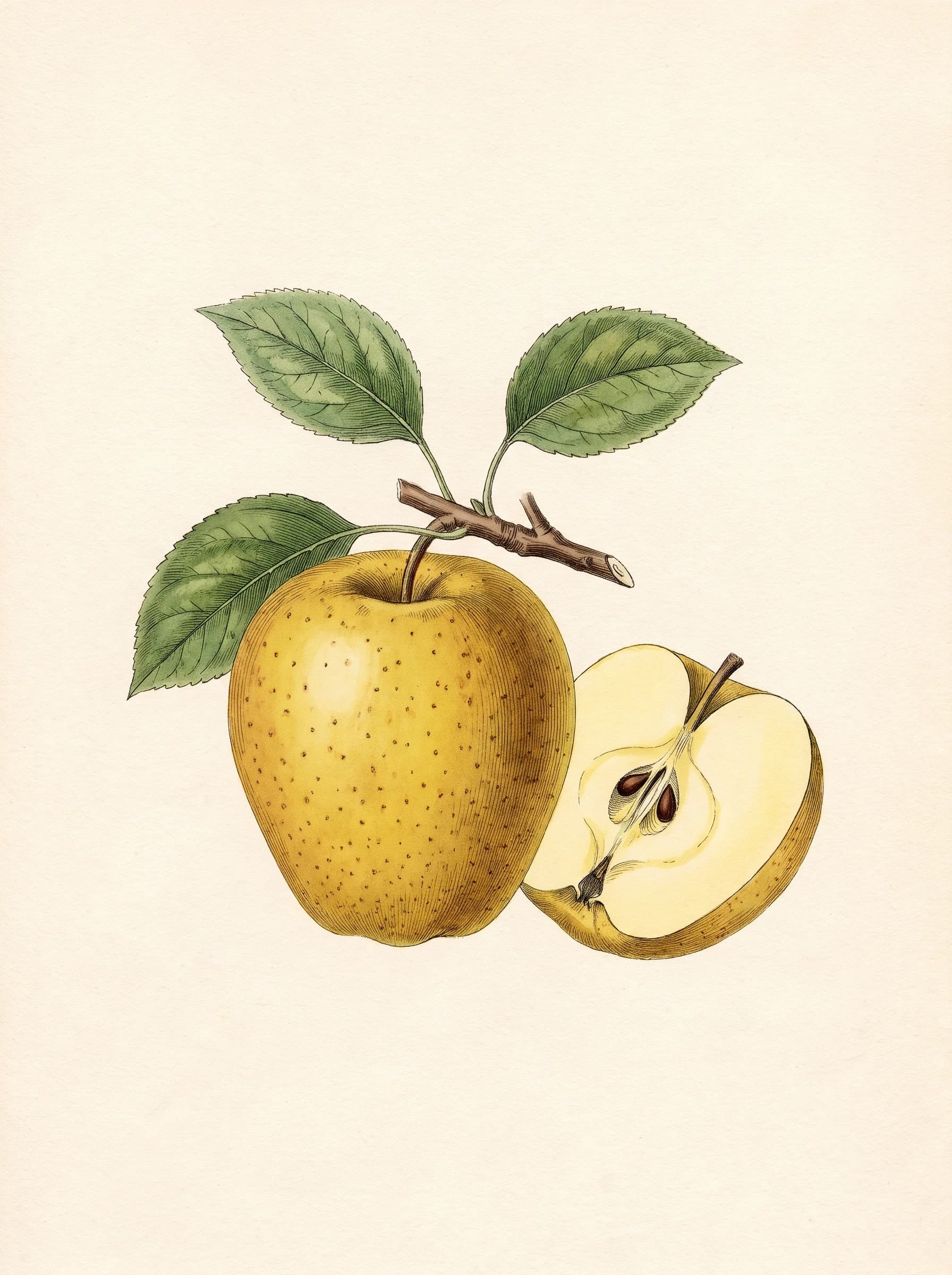
Fruits · apple
Golden Delicious
Mild and honey sweet, in the New York Apple Association’s description.
1 of 5 from sweet (1) to very tart (5). Rated from the New York Apple Association’s profile, “mild, sweet flavor.”
- Origin
- Clay County, West Virginia, as a chance seedling near Porter Creek. Dates and details differ. e-WV says the tree was discovered in 1912 by Anderson Mullins and had sprouted around the turn of the century. The University of Missouri Extension says A. H. Mullins sent three apples to Stark Bro’s in 1912. In a 1962 Charleston Daily Mail interview, J. M. Mullins said he found the seedling as a boy about 1891 on his father’s farm and left it standing.
- Season
- Lower Midwest: September, among the heirloom apples at peak in farm markets (University of Missouri Extension). The New York Apple Association lists New York fruit as available September through June.
- In the oven
- Softens, and sources disagree on its value in pie. King Arthur Baking says Red and Golden Delicious can become mushy in a pie and lose some of their sweetness. The New York Apple Association rates Golden Delicious good for pies and baking, and advises using less sugar because of its natural sweetness.
Golden Delicious is a yellow apple from a single seedling tree in Clay County, West Virginia, bought and named by Stark Bro’s Nurseries in the 1910s. e-WV says it soon became a leading cultivar in the United States and abroad. It is West Virginia’s state fruit.
e-WV records that the original tree, believed related to Grimes Golden, was discovered by Anderson Mullins in 1912 on a hill near Porter Creek, and that Stark Bro’s bought it, caged it and paid Bewel Mullins to keep records on it for thirty years. The University of Missouri Extension says Paul Stark traveled to the tree and that Stark Bro’s paid $5,000 for the rights to the tree and the ground around it. In 1962, J. M. Mullins told the Charleston Daily Mail that he had spared the seedling while mowing around 1891, that the family called a similar small yellow apple the “Annit apple,” and that the first payment was $50 for the tree’s fruit, not $5,000.
The mother tree bore for nearly fifty years and was dead by the late 1950s, according to e-WV; a historical marker on Route 1 marks the site. West Virginia designated Golden Delicious the state fruit on February 20, 1995, and Clay County has held a Golden Delicious Festival each fall since 1972. The University of Missouri Extension notes that it is a parent of many later cultivars, including Gala. Despite the shared name, the New York Apple Association notes that it is related to Red Delicious in name only.
Its sweetness and soft texture divide bakers. The New York Apple Association recommends it for pies and suggests cutting the sugar. King Arthur Baking warns that the Delicious apples can turn mushy in a pie; to represent the Delicious family in its test it used Ginger Gold, a Golden Delicious cross, which baked into distinct but very soft slices.
Sources
- Golden Delicious, e-WV: The West Virginia Encyclopedia (West Virginia Humanities Council, rev. 2024)
- Heirloom apples are ripe for the picking, University of Missouri Extension (2021)
- Dunbar Man ‘Discoverer’ of Golden Delicious Apple (Adrian Gwin, Charleston Daily Mail, October 18, 1962), West Virginia Archives and History
- Golden Delicious, New York Apple Association
- The best apples for apple pie: Here’s how to choose (PJ Hamel, King Arthur Baking)