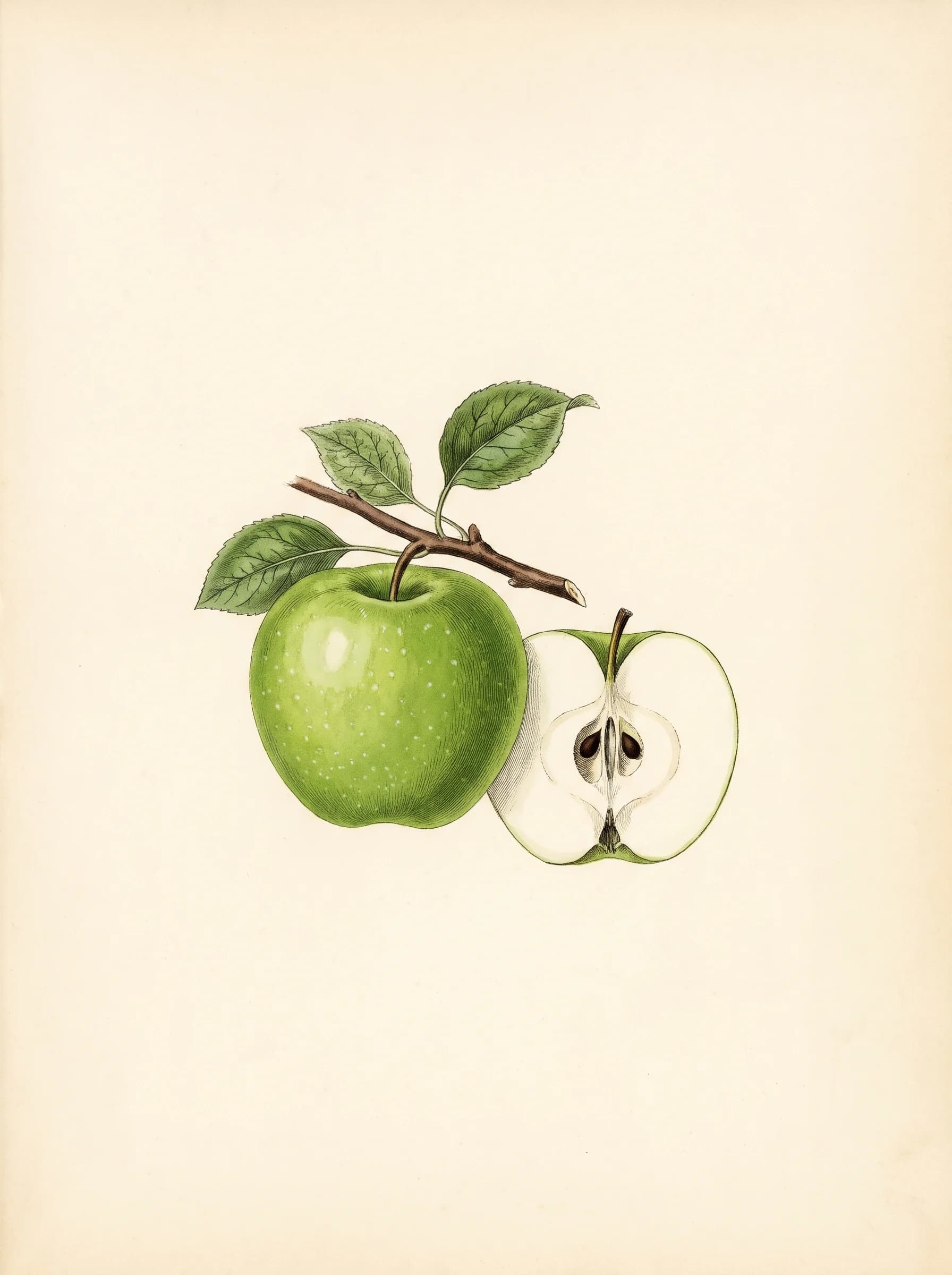
Fruits · apple
Granny Smith
Crisp and juicy, with a balance of tart and sweet, in the New York Apple Association’s description.
4 of 5 from sweet (1) to very tart (5). Rated from the New York Apple Association’s profile, “an enjoyable tart taste”; King Arthur’s baked test found “medium sweetness with a touch of tang.”
- Origin
- Eastwood, New South Wales, Australia. The City of Ryde and the Dictionary of Sydney both date the seedling to 1868. That date rests on a fruit grower’s recollection printed in the Farmer and Settler on 25 June 1924; the earliest contemporary records are show entries of 1890 and 1891.
- Season
- Late October, in Stark Bro’s Nurseries’ description of the tree (no growing region stated). The New York Apple Association lists New York fruit as available September through August, from storage.
- In the oven
- Holds its shape. In King Arthur Baking’s side-by-side test of six varieties, Granny Smith baked “crisp/tender, a bit firmer than Northern Spy” and its slices held their shape; the tester judged it the best combination of taste and texture in the trial. The New York Apple Association rates it great for baking.
Granny Smith is a green apple that arose as a chance seedling at Eastwood, near Sydney, and is named for Maria Ann Smith. It ripens late and keeps for months. In American kitchens it is the firm, tart apple available in every season.
The City of Ryde’s local history service traces the earliest account of the apple to the Farmer and Settler of 25 June 1924. In it a fruit grower, Edwin Small, recalled that in 1868 Maria Ann Smith invited him and his father to look at a seedling apple growing by a creek on her farm. She told them it had come from the remains of French crab apples grown in Tasmania. The record after that is documentary: “Smith’s seedling” was shown at the Castle Hill show in 1890, “Granny Smith’s seedlings” won the prize for cooking apples there in 1891, and by 1892 many growers were exhibiting the variety. In 1895 Albert H. Benson named it a suitable variety for export.
The tree ripens its fruit late in the season, typically in late October by Stark Bro’s account, and the apples keep for up to six months in good storage. The New York Apple Association, which counts it among the varieties grown in New York, lists it as available almost the whole year. Eastwood has held a Granny Smith Festival since 1957, run by Ryde City Council since 1985, according to the Dictionary of Sydney. The apple was one of four varieties on a 2013 United States postage issue, with Golden Delicious, Northern Spy and Baldwin, as recorded by e-WV.
In King Arthur Baking’s six-variety pie test, Granny Smith baked a bit firmer than Northern Spy and its slices held their shape; only the russet was firmer. The tester reported baking many all-Granny Smith pies, especially in winter, when other apples are scarce or expensive. Her recommended fall pie used three apples: Cortland for flavor, a russet for texture, and Granny Smith for both.
Sources
- Granny Smith, City of Ryde Library, Local and Family History
- Granny Smith Festival, The Dictionary of Sydney
- Granny Smith Apple Tree, Stark Bro’s Nurseries & Orchards Co.
- Granny Smith, New York Apple Association
- The best apples for apple pie: Here’s how to choose (PJ Hamel, King Arthur Baking)
- Golden Delicious, e-WV: The West Virginia Encyclopedia (West Virginia Humanities Council, rev. 2024)