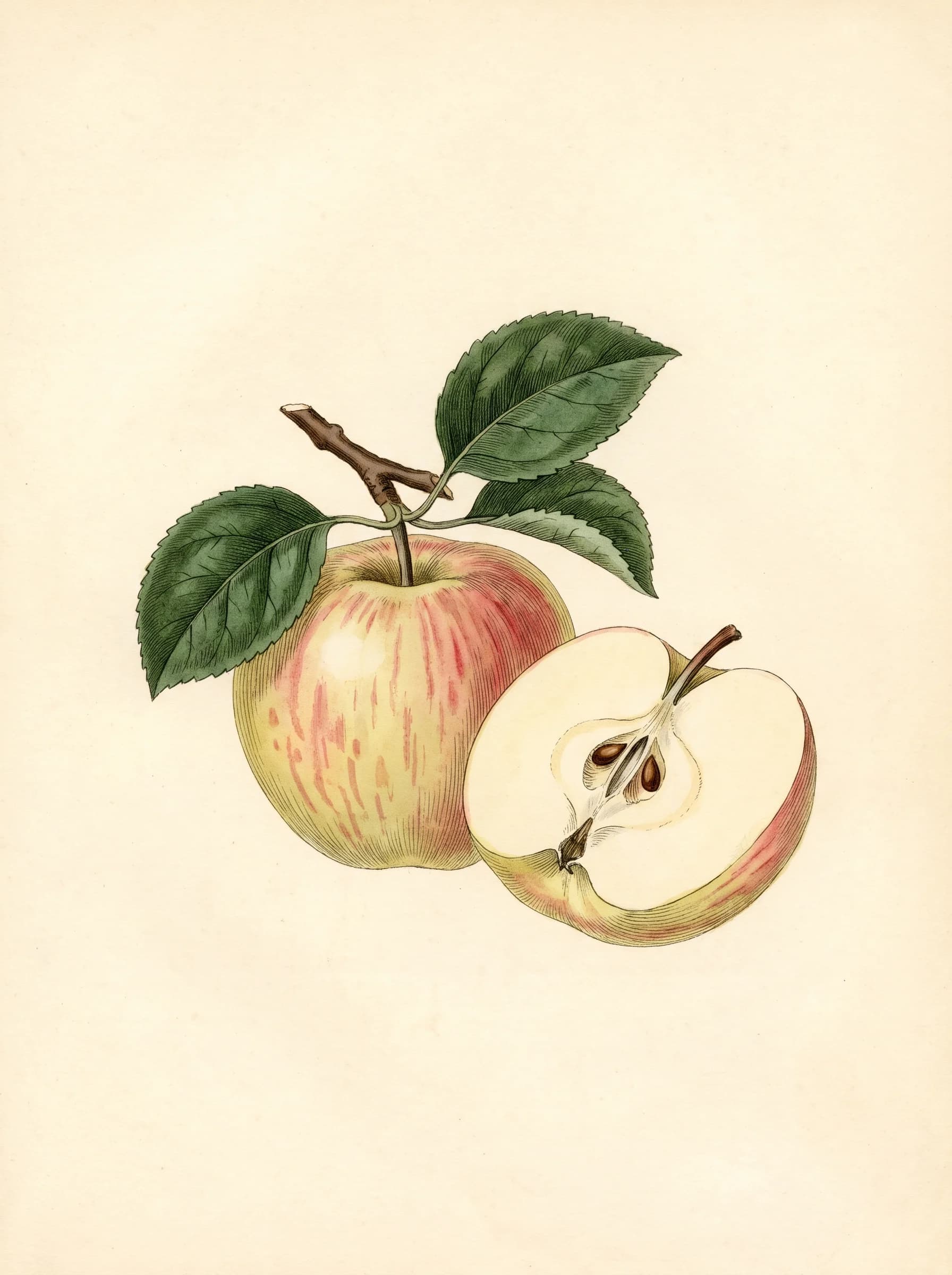
Fruits · apple
Northern Spy
Sweet-tart and complex, in Stark Bro’s description.
3 of 5 from sweet (1) to very tart (5). Rated from Stark Bro’s description of a “complex sweet-tart character”; King Arthur’s baked test found it “sweet, mildly ‘apple-y.’”
- Origin
- East Bloomfield, New York, in a seedling orchard planted by Heman Chapin with seed brought from Salisbury, Connecticut, about 1800 (Beach, 1905). Stark Bro’s gives the same place and describes two centuries of cultivation. Beach records that it was little known outside its district until about 1840 and was listed by the American Pomological Society in 1852.
- Season
- October harvest, in Stark Bro’s description. Beach (1905) reports that in parts of New York it needs two to three weeks longer than Rhode Island Greening to ripen properly, and that the fruit is ready for use in November and December.
- In the oven
- Holds its slices but softens. King Arthur Baking’s test found it “medium firm; slices were distinct, yet soft.” Beach (1905) called the flesh very juicy and tender and “most excellent for either dessert or culinary uses,” and noted it was too juicy and tender for evaporating. A 1961 study in the Journal of the American Pomological Society placed Northern Spy among the six varieties that made the highest-quality frozen pies from fresh fruit.
Northern Spy is a large, red, late-ripening New York apple from about 1800. Beach ranked it among the very best winter apples of the state. It is a long-standing pie apple of the Northeast and a grandparent of Honeycrisp.
S. A. Beach’s The Apples of New York (1905) traces the variety to a seedling orchard at East Bloomfield, New York, planted by Heman Chapin about 1800 from seed brought from Salisbury, Connecticut. The original tree died before it bore. Roswell Humphrey took up sprouts from it and raised the first fruit, and nine of his trees were still alive in 1847. The variety stayed local until about 1840, and in 1852 the American Pomological Society listed it as worthy of general cultivation.
In 1905 Northern Spy ranked third in commercial importance among New York apples, behind Baldwin and Rhode Island Greening. Beach described a hardy, upright tree that blooms remarkably late, so its blossoms sometimes escape frost, but that is slow to come into bearing and needs careful pruning. Its thin skin and tender flesh bruise easily. The tree’s vigor made it a favored stock for top-working weaker varieties. The University of Minnesota lists Keepsake, a parent of Honeycrisp, as bred from MN447 crossed with Northern Spy.
King Arthur Baking’s tester chose Northern Spy as one of her two favorite pie apples before her six-variety test, and found that it baked medium firm, with distinct but soft slices. A 1961 frozen-pie study ranked it with Jonathan, Stayman Winesap, Red Delicious, Melba and Ruby among the varieties that made the highest-quality frozen pies from fresh fruit.
Sources
- The Apples of New York, vol. 1 (S. A. Beach, New York Agricultural Experiment Station, 1905), Internet Archive
- Northern Spy Apple Tree, Stark Bro’s Nurseries & Orchards Co.
- The best apples for apple pie: Here’s how to choose (PJ Hamel, King Arthur Baking)
- Varietal Differences in Frozen Apple Pies, Journal of the American Pomological Society (Fruit Varieties) 15(4) (1961)
- Honeycrisp, Minnesota Hardy, University of Minnesota