Fruits · apple
Gravenstein
Crisp, juicy and sweet yet tart, in the Slow Food Foundation’s description.
3 of 5 from sweet (1) to very tart (5). Rated from Beach’s 1905 description, “sprightly subacid, aromatic,” and Slow Food’s “sweet yet tart flavor.”
- Origin
- Uncertain; northern Europe, by the mid-eighteenth century. Beach (1905) quotes Hovey (1851): the original tree was said to grow in the Duke of Augustenburg’s garden at Gravenstein in Holstein in the middle of the eighteenth century, or at the castle of Grafenstein in Schleswig, and Diel reported a belief that it came from Italy. In the United States, Beach records a Captain DeWolfe’s 1857 statement that he imported it from Denmark in May 1826, and Hovey’s view that it reached the Albany area probably before 1826. The Slow Food Foundation states that it was first planted in Sonoma County, California, in 1811 by Russian trappers at Fort Ross.
- Season
- Sonoma County, California: late July, in the Slow Food Ark of Taste entry, or the beginning of August, in the Slow Food Presidium entry. New York: late September to early November, picked two or three times as the crop ripens unevenly (Beach, 1905).
- In the oven
- Juicy, aromatic and tender-skinned. Beach (1905) wrote that for culinary purposes it was “perhaps unexcelled by any variety of its season.” Slow Food notes that the fruit is soft-skinned, delicate and perishable, and that during the Second World War Gravensteins supplied applesauce and dried apples for United States troops. No test-kitchen account of its texture in pie has been found.
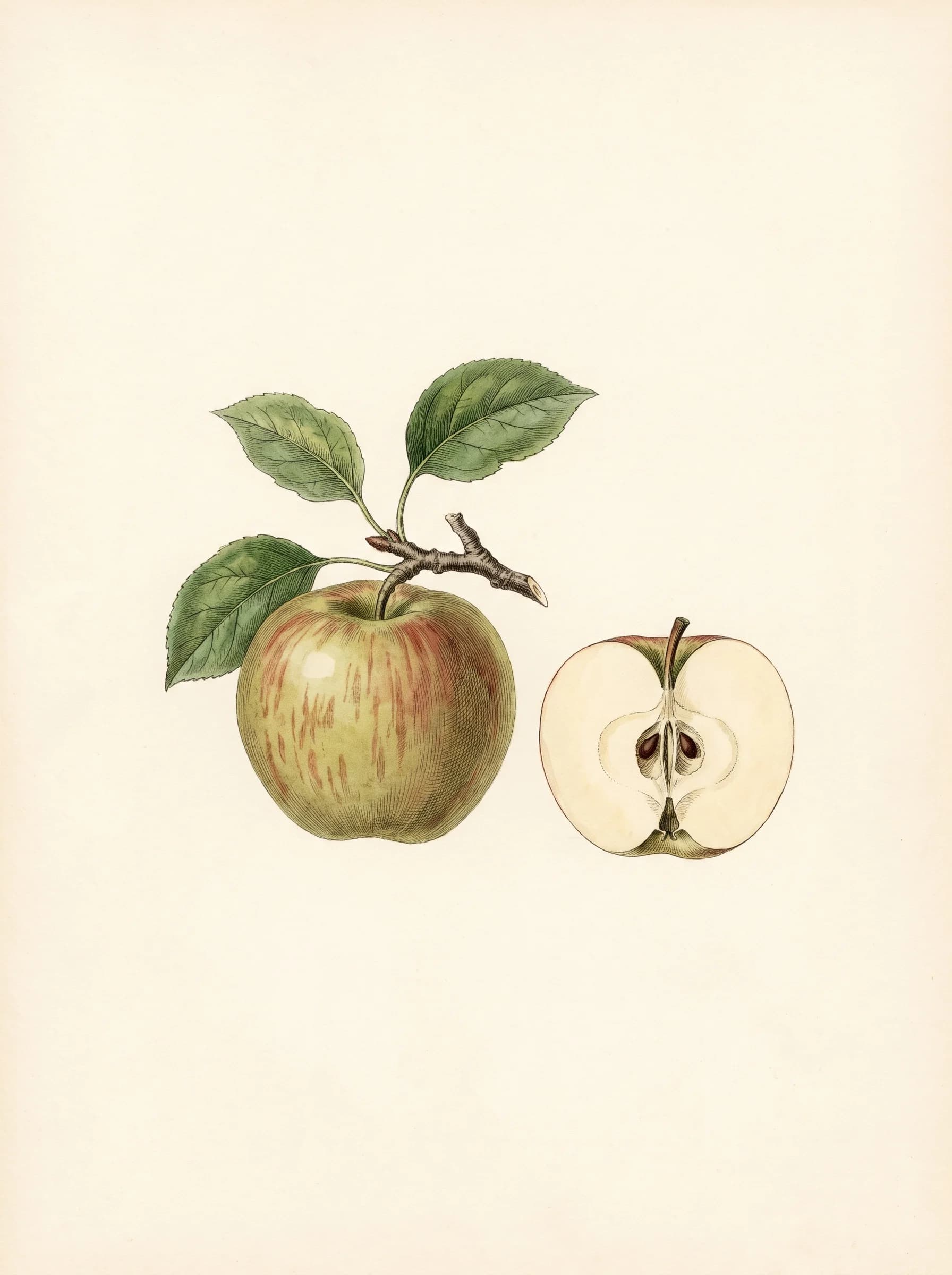
Gravenstein is an old northern European apple, yellow-green with red striping, that became the signature early apple of western Sonoma County, California. It ripens in summer, keeps poorly, and was long prized for cooking. Slow Food lists it in its Ark of Taste and supports it as a Presidium.
Its origin was already in doubt by 1851, when Charles Hovey summarized the competing accounts later reprinted by S. A. Beach: a tree in the Duke of Augustenburg’s garden at Gravenstein in Holstein, a castle garden at Grafenstein in Schleswig, or an import from Italy. Hovey placed it among the German apples received into English collections, described by the London Horticultural Society in 1822. In America, a Captain DeWolfe stated in 1857 that he had brought it from Denmark in 1826. The Slow Food Foundation states that Russian trappers planted it at Fort Ross, on the Sonoma coast, in 1811.
The fruit is large, yellow to orange-yellow under broken red stripes, and ripens over several weeks, so growers pick it two or three times. Beach found the tree somewhat subject to sunscald and canker in New York. The Slow Food Presidium entry records that Sonoma County once had more than 7,000 acres of Gravenstein orchards and now has just under 900, many replaced by vineyards; its short stems, uneven ripening and soft skin make it hard to pick, ship and store. Slow Food started its Presidium with Sebastopol producers in 2006.
Beach ranked the Gravenstein at the top of its season for culinary use. Because the fruit ripens in summer and keeps poorly, Slow Food reports that it is now found mostly at local farmers’ markets. One Presidium farm, run by the Kolling family since 1979, turns its organic Gravensteins into juice, cider and vinegar sold to a local bakery and nearby restaurants.