Fruits · apple
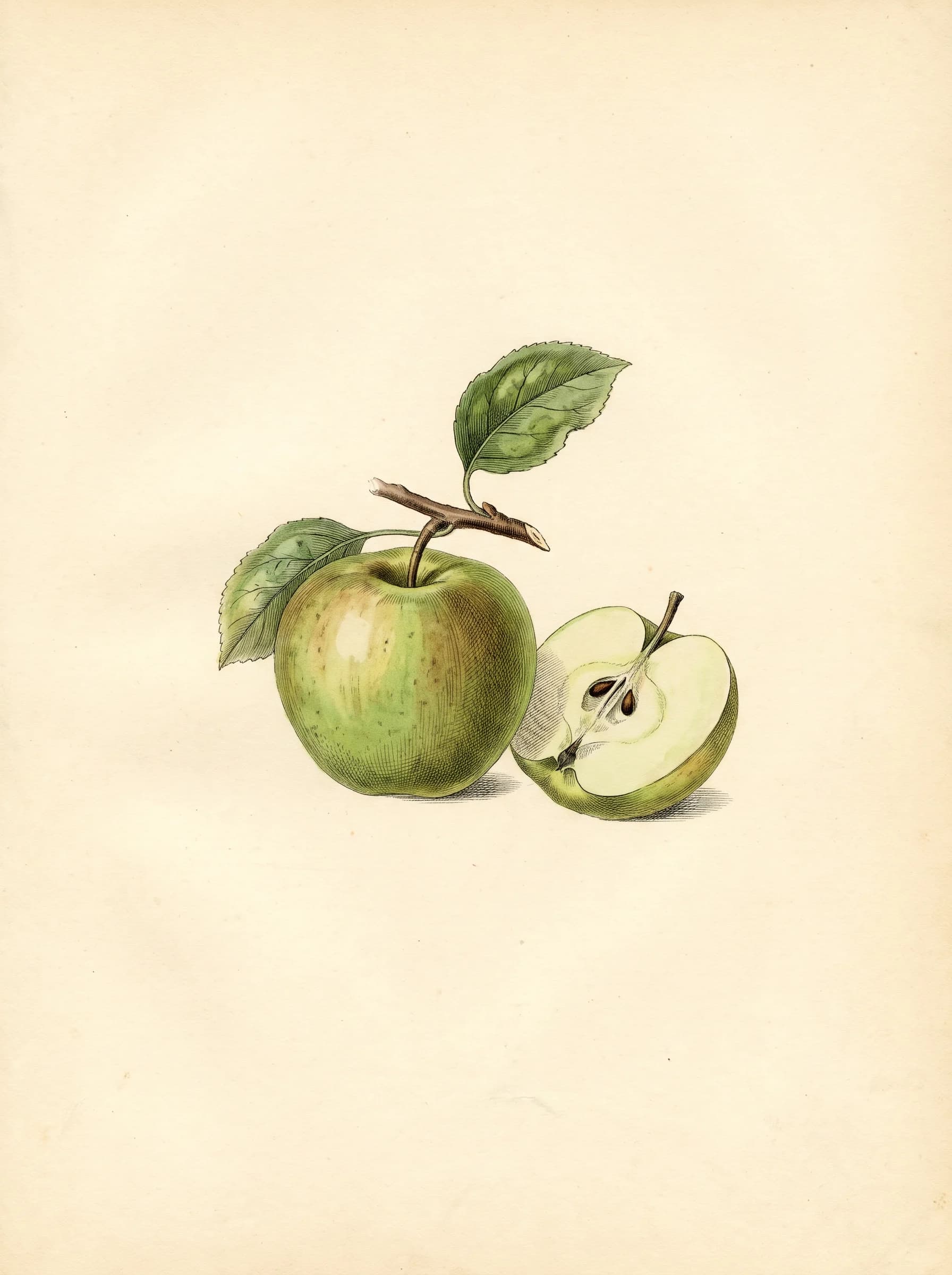
Rhode Island Greening
Rich and sprightly subacid, in Beach’s 1905 description.
4 of 5 from sweet (1) to very tart (5). Rated from Charles Hovey’s 1851 description quoted by Beach, “to some tastes it is rather acid,” and the Rhode Island Department of State’s note that it retains a “sharp taste in cooking.”
- Origin
- Rhode Island, probably near Newport at Green’s End, in the colonial period; the exact place and date are not known. Beach (1905) cites an account of a tavern keeper named Green who raised apple trees from seed, and a Rhode Island tree whose parent, planted in 1748, was cut down in 1889. The Rhode Island Department of State gives the date as around 1760. The New England Historical Society repeats Wikipedia’s version, which dates it to around 1650, and a separate legend that credits Metcalf Bowler of Portsmouth.
- Season
- New York: picked before Baldwin in autumn; in ordinary storage, in season from October to March or April (Beach, 1905).
- In the oven
- A classic cooking apple. Beach (1905) called it one of the very best cooking apples grown and “decidedly superior to Baldwin for all culinary purposes,” and quoted Hovey: “As a cooking apple, the Greening is unsurpassed.” The Rhode Island Department of State notes that it keeps its sharp taste when cooked. No modern test-kitchen account of how it holds its shape has been found.
The Rhode Island Greening is a large green apple from colonial Rhode Island, for two centuries one of the leading cooking apples of the Northeast. In 1905 it was second only to Baldwin in New York orchards. Rhode Island named it the official state fruit in 1991.
Beach’s account in The Apples of New York (1905) places the origin near Newport, at Green’s End, where a tavern keeper named Green raised trees from seed. Travelers took so many scions from one large green apple that the tree is said to have died of the cutting. The fruit was known in Rhode Island as the apple from Green’s Inn. Beach also cites a tree at Fruit Hill whose parent was planted in 1748 and cut down in 1889, and a 1765 introduction to the old Plymouth colony. Beach’s own station tested scions from a reputed original tree on the Drowne farm in Foster and found that tree was not the original.
The apple is grass-green in autumn and yellows as it ripens. In 1905 it was grown more extensively in New York than any variety but Baldwin, and growers planted the two together, since Greening could be picked and sold before Baldwin. Beach found it productive but susceptible to scab, and noted that eastern markets preferred the green fruit as a sign it was not overripe. In 1965, by Way and Brown’s account, McIntosh and Rhode Island Greening were still the two leading cultivars in New York State.
Its standing in the kitchen is older than its commercial rank. Hovey wrote in 1851 that as a cooking apple it was unsurpassed, and Beach judged it decidedly superior to Baldwin for all culinary purposes. Rhode Island’s General Assembly designated the Rhode Island greening the official state fruit in 1991; the Department of State gives the date of adoption as June 20, 1991.
Sources
- The Apples of New York, vol. 1 (S. A. Beach, New York Agricultural Experiment Station, 1905), Internet Archive
- R.I. Gen. Laws § 42-4-13, Official state fruit, State of Rhode Island General Assembly
- Rhode Island State Symbols, Rhode Island Department of State
- The Greening Apple’s Journey From Persia to Rhode Island, New England Historical Society
- ‘Cortland’ Apple (Roger D. Way and Susan K. Brown, Fruit Varieties Journal 51(2), 1997)