Fruits · berry
Marionberry
Distinctively sweet with a mildly tart and lasting flavor, in the Willamette Heritage Center’s description.
3 of 5 from sweet (1) to very tart (5). Rated from the Willamette Heritage Center’s description, “distinctively sweet, yet has a mildly tart and lasting flavor.”
- Origin
- Corvallis, Oregon, from the USDA Agricultural Research Service breeding program run with the Oregon Agricultural Experiment Station. George F. Waldo made the cross Chehalem × Olallie in 1945, selected it in 1948, and it was released in 1956, named for Marion County, where it was tested extensively (Finn, Strik and Lawrence, 1997; Oregon HCR 19, 2017). The Willamette Heritage Center gives the same 1945 start and 1956 release.
- Season
- Willamette Valley, Oregon: the crop begins to ripen at the end of June, with commercial harvest from the first week of July to late July (Finn, Strik and Lawrence, 1997). The Oregon Raspberry & Blackberry Commission gives the harvest as early July to early August.
- In the oven
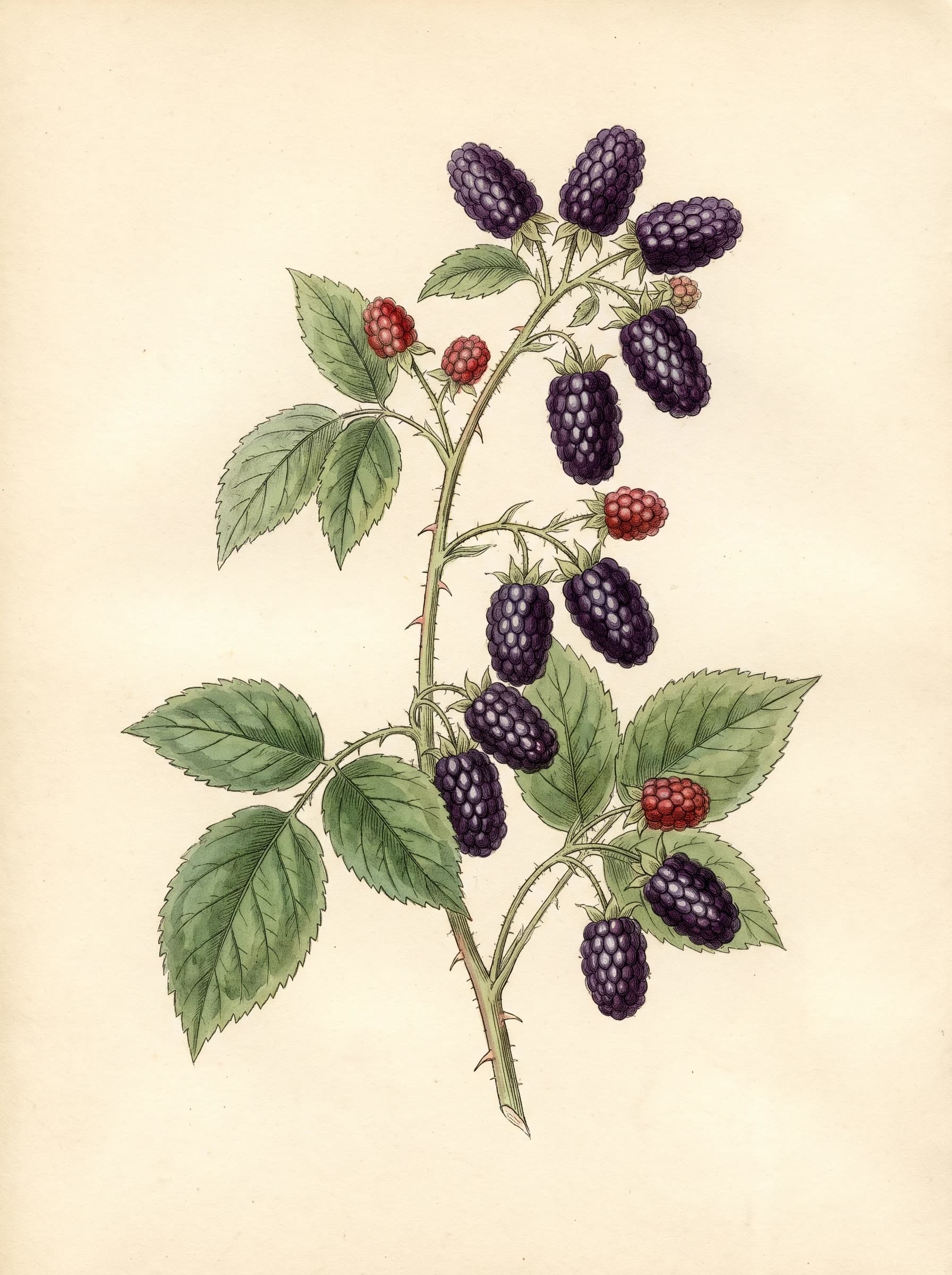
- Soft and very juicy. Finn, Strik and Lawrence (1997) note that ripe fruit keeps its color well when processed, and that lack of firmness limits its fresh use. The Oregon Raspberry & Blackberry Commission describes the berries as dark purple to black, and Wikipedia states that they turn a deep, dark purple when frozen and thawed. King Arthur Baking’s thickener guide says blackberries are very juicy, release even more liquid after freezing, and need more thickener than apples.
The marionberry is a trailing blackberry released in 1956 by the USDA and Oregon’s agricultural experiment station, and named for Marion County. Finn and colleagues called it the most widely planted blackberry cultivar in the world in 1997. Oregon designated marionberry pie its official state pie in 2017.
Finn, Strik and Lawrence record that the USDA-ARS breeder George F. Waldo, working in Corvallis, crossed Chehalem with Olallie in 1945 and selected the seedling in 1948 as OSC 928. It was released in 1956 and named Marion. Its pedigree mixes the western trailing blackberry with Himalaya blackberry, other blackberries and red raspberry, and the authors write that it may never be fully determined. Consumers and marketers often call it marionberry.
Marion is a hexaploid trailing blackberry with few, very long canes. Poor winter hardiness has kept production in the Willamette Valley, and the crop is harvested in July, more than 85 percent by machine according to Finn and colleagues. Oregon State University Extension notes that trailing types do not spread readily from roots or seed, and that no wild Marion has been found since 1956. Figures for its concentration differ in kind: the legislature’s 2017 resolution says 95 percent of the world’s Marion blackberries grow in Oregon, while the committee staff summary and the Willamette Heritage Center say about 90 percent grow near Salem.
About 95 percent of the Pacific Northwest blackberry crop is processed, by Finn and colleagues’ figures, and ripe Marion fruit keeps its color well in processing. Oregon’s House adopted House Concurrent Resolution 19 on May 8, 2017, and the Senate on July 6, 2017, designating marionberry pie the official pie of the State of Oregon. The committee staff summary lists the other state pies of the time: Florida’s Key lime, Illinois’s pumpkin, Texas’s pecan, Indiana’s sugar cream and Vermont’s apple.
Sources
- ‘Marion’ Trailing Blackberry (Chad Finn, Bernadine Strik and Francis J. Lawrence, Fruit Varieties Journal 51(3), 1997)
- House Concurrent Resolution 19, enrolled, Oregon Legislative Assembly (2017)
- HCR 19 A Staff Measure Summary, Oregon House Committee on Rules (2017)
- Marionberries: A Delicious Part of Salem’s Past, Willamette Heritage Center
- Are marionberries invasive?, Oregon State University Extension Service
- Pie Thickener Guide, King Arthur Baking
- Marionberry, Oregon Raspberry & Blackberry Commission
- Marionberry, Wikipedia