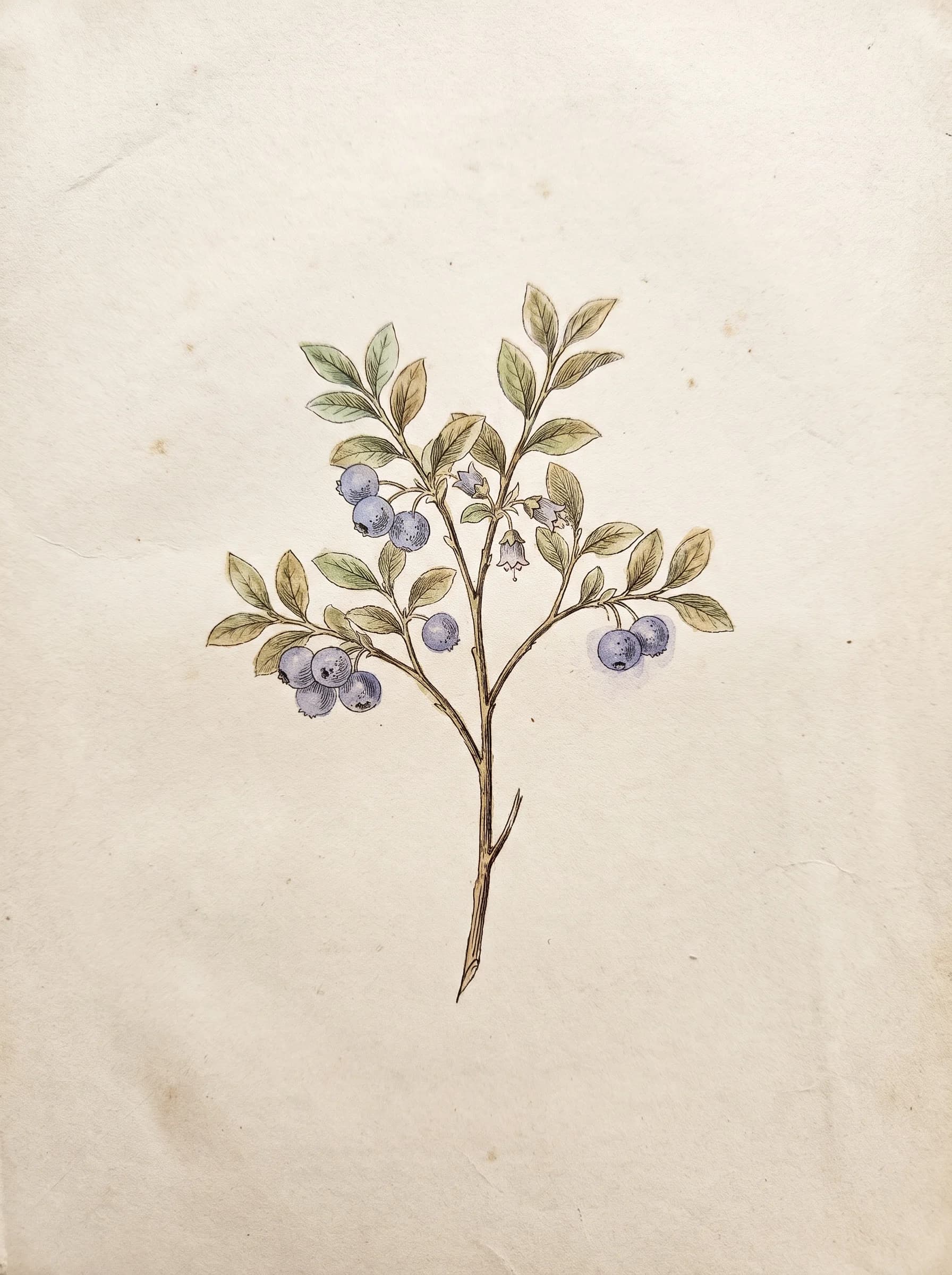
Fruits · berry
Wild blueberry
Fruity and sweet in aroma, in the 2022 Foods study’s description.
2 of 5 from sweet (1) to very tart (5). Rated from a 2022 study in Foods that found wild lowbush blueberries would give food products “fruitier” and “sweeter” flavors than cultivated highbush fruit.
- Origin
- Native to northern New England and Atlantic Canada (University of Maine Cooperative Extension). Extension records that the Wabanaki people first managed it on a large scale by burning and harvesting fields, and that it is one of three commercially grown crops native to North America.
- Season
- Maine: harvested in August, by the University of Maine Cooperative Extension’s account, or from late July to early September, by the Maine Secretary of State’s.
- In the oven
- Small berries with more skin than cultivated fruit. Highbush berries average about four times the size of wild lowbush berries, with more pulp and less skin (Foods, 2022). King Arthur Baking’s thickener guide says blueberries are high in pectin and need a little less thickener than other berries. About 99 percent of Maine’s crop is sold frozen.
The wild blueberry is the native lowbush blueberry of Maine and Atlantic Canada. It is not planted but managed in fields on a two-year cycle of crop and pruning. Maine law names blueberry pie made with wild Maine blueberries the official state dessert.
University of Maine Cooperative Extension records that the Wabanaki people first grew the crop on a large scale, burning and harvesting the fields. By the 1600s English settlers on the Maine coast picked the barrens as a public privilege. Wild blueberries were shipped by sea to the Union Army during the Civil War, were first canned in 1886, and by the 1950s supported 21 canning factories. In 1945 Maine growers asked to be taxed to fund research and promotion, the origin of the Wild Blueberry Commission of Maine.
The plants grow in fields on mountaintops and glacial outwash plains, and a single field can hold up to 1,500 genetically distinct plants, which is why the berries are called wild. Fields alternate between a prune year, when plants are mowed or burned to the ground after the August harvest, and a crop year. Maine has about 38,000 acres of commercial wild blueberry land managed by about 500 farmers, and 99 percent of the crop is frozen. Extension notes that several lowbush species grow in the fields, with Vaccinium angustifolium the most abundant.
Maine’s legislature designated blueberry pie made with wild Maine blueberries the official state dessert in 2011 (1 M.R.S. §226). The small berries carry more skin for their size than cultivated highbush fruit, and King Arthur Baking notes that blueberries’ high pectin lets a pie set with less thickener than other berries.
Sources
- About the Maine Wild Blueberry, University of Maine Cooperative Extension
- Lowbush Blueberry (Vaccinium angustifolium), Signs of the Seasons, University of Maine Cooperative Extension
- Maine Revised Statutes Title 1, §226, State dessert
- State Dessert - Blueberry Pie, Maine Secretary of State Kids’ Page
- Comparison of Volatile Compounds Contributing to Flavor of Wild Lowbush and Cultivated Highbush Blueberry Fruit (Foods, 2022), PubMed Central
- Pie Thickener Guide, King Arthur Baking