Fruits · stone fruit
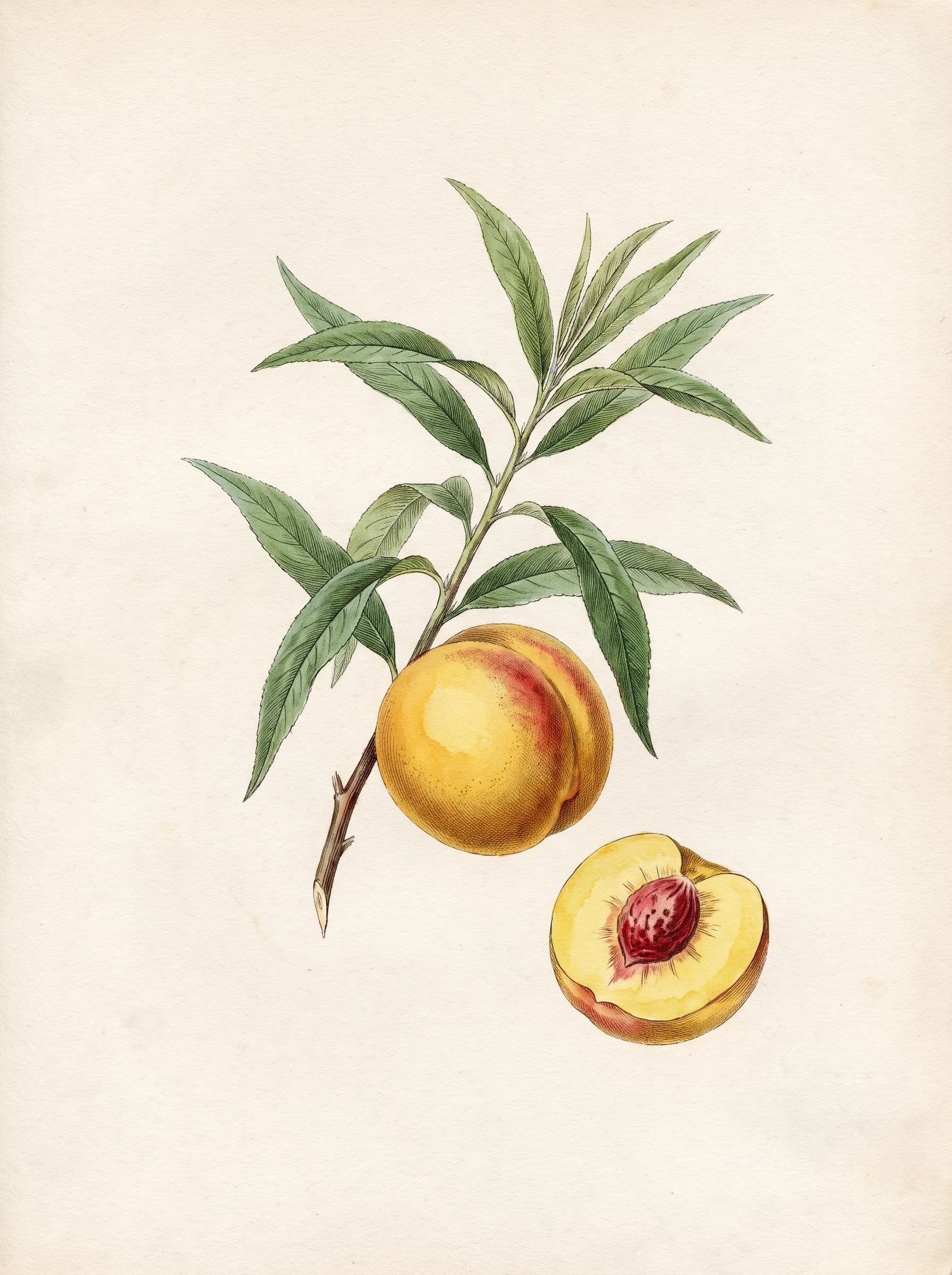
Peach
A blend of acidic tanginess and sweetness, in Clemson Extension’s description.
2 of 5 from sweet (1) to very tart (5). Rated from Clemson Extension’s description of most market peaches as a “blend of acidic tanginess and sweetness.”
- Origin
- China. Two Clemson Extension pages differ on the date: one says peaches have been cultivated in China for over 3,000 years, the other cites archaeological evidence of cultivation by 8,000 to 7,000 B.C. They also differ on arrival in North America: one says Spanish missionaries brought peaches to the New World in 1571, the other cites Penn State’s dating of peach pits from the Muskogee Farm site in Georgia’s Oconee Valley to between 1520 and 1550.
- Season
- Georgia: from about the first of May to the second week of August (University of Georgia, 2004).
- In the oven
- Juicy and soft when ripe. King Arthur Baking’s thickener guide says peaches have less pectin than apples and are juicier, so they need more thickener. Clemson Extension says early-season clingstone peaches are best for cooking and canning, freestone peaches are good for desserts and cooking, and peeled peaches should be treated with lemon or orange juice to prevent browning.
The peach is a stone fruit from China that reached the American Southeast with the Spanish in the sixteenth century. Georgia’s commercial industry grew from the Elberta peach, introduced by Samuel H. Rumph in the 1870s. Delaware names peach pie its state dessert.
Clemson Extension notes that the name Prunus persica, Persian apple, led some to believe the peach came from Persia, while archaeological and historical records place its origin in China. It spread along trade routes through Persia and India to the Mediterranean, and with the Spanish to the Americas. Within a century of the founding of Saint Augustine, Clemson reports, accounts described dense wild stands of peach trees from Charleston to New York.
The University of Georgia traces the state’s industry to Samuel H. Rumph of Marshallville. Seeds of a Chinese Cling tree in his family’s orchard were planted in 1870; one seedling bore an exceptional yellow freestone, which a family friend named Elberta for Rumph’s wife, Clara Elberta Moore. UGA dates the Elberta to 1875, when Rumph shipped un-iced fruit to New York and sold it for fifteen dollars a bushel; it was marketed in volume from 1880. Clemson’s account of the same story says the seeds were saved by his grandmother.
Clemson Extension divides peaches into clingstone, freestone and semi-freestone types, and recommends the early clingstones for cooking and canning. Most home canners use melting-flesh freestones, which are easier to handle. Delaware claims peach pie as its state dessert, according to Clemson Extension.
Sources
- Peaches: The Story of South Carolina’s Non-native State Fruit, Clemson Home & Garden Information Center
- Different Kinds of Peaches (Desmond Layne), Clemson Home & Garden Information Center
- Using & Storing Peaches, Clemson Home & Garden Information Center
- History, Georgia Peaches, University of Georgia College of Agricultural and Environmental Sciences
- Georgia peach crop best in decade (Brad Haire, UGA CAES Field Report, 2004)
- Pie Thickener Guide, King Arthur Baking