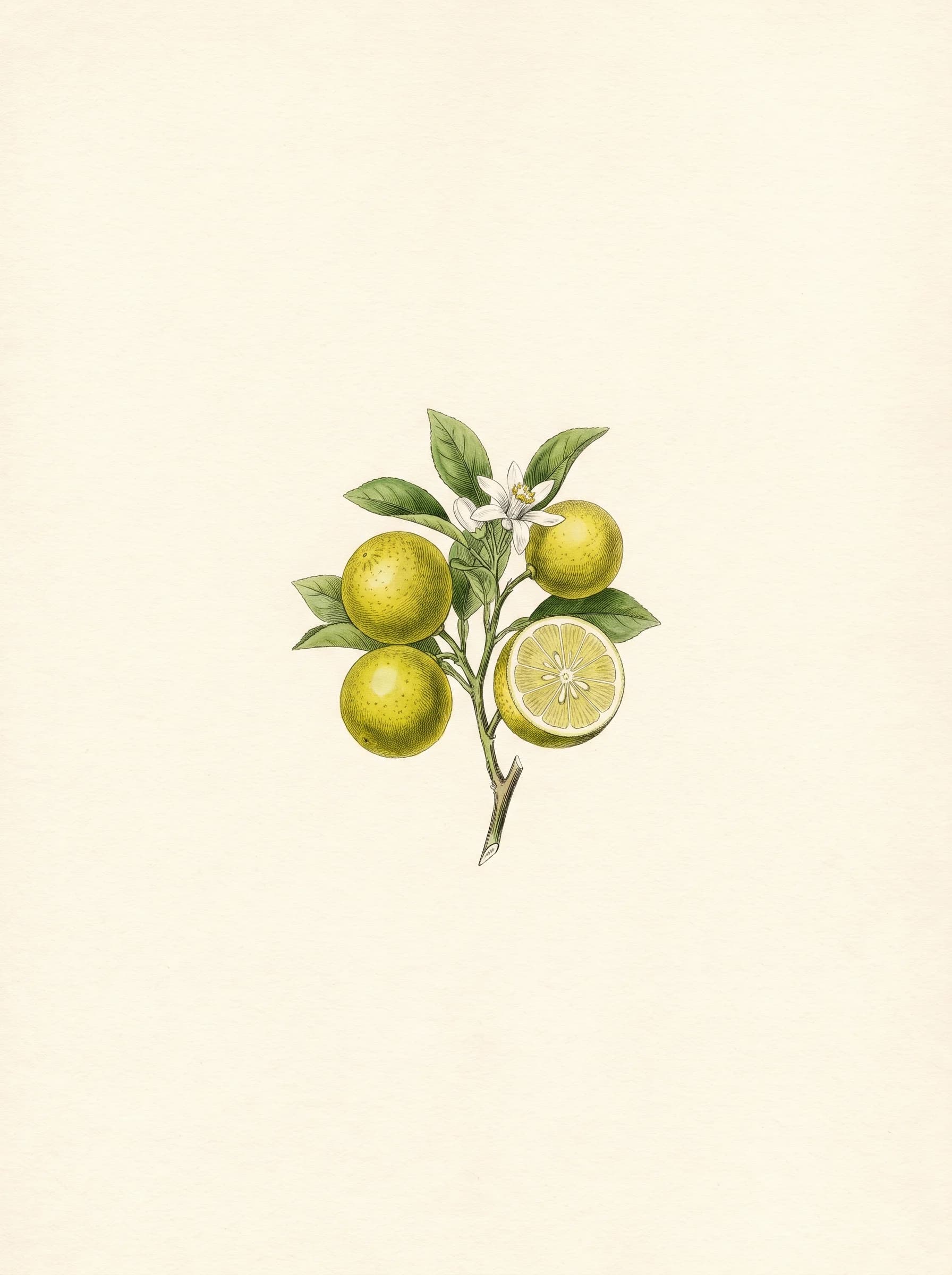
Fruits · citrus
Key lime
Highly acid with a distinctive aroma, in UF/IFAS’s description.
5 of 5 from sweet (1) to very tart (5). Rated from UF/IFAS’s description of the pulp as “juicy, and highly acid with a distinctive aroma.”
- Origin
- Southeast Asia; UF/IFAS describes it as probably a three-way hybrid of citron, pummelo and a microcitrus species. It was carried by the Arabs across North Africa to Spain and Portugal, brought to the Americas by Spanish and Portuguese explorers in the early sixteenth century, and became naturalized in the Caribbean and the Florida Keys (UF/IFAS, citing Ziegler and Wolfe, 1961).
- Season
- South Florida: principal season early summer, with some fruit maturing year-round; further north, late summer (UF/IFAS).
- In the oven
- Used for juice. The acid of Key lime juice reacts with the proteins in sweetened condensed milk and thickens the filling, so WFAE’s eggless version needs no baking; WFAE adds that many recipes with eggs require baking (WFAE, 2018). Eagle Brand’s published recipe bakes a filling of condensed milk, juice and egg yolks for 20 minutes at 350°F. UF/IFAS lists pies among the fruit’s uses. The fruit is greenish yellow to yellow at maturity, and its pulp greenish yellow.
The Key lime is a small, seedy, highly acid lime naturalized in the Florida Keys. Commercial production in Florida has nearly ended, though the tree remains a popular home landscape fruit. Florida designated Key lime pie its official state pie in 2006.
UF/IFAS Extension’s Jonathan H. Crane traces the Key lime to Southeast Asia and describes it as probably a three-way hybrid involving citron, pummelo and Citrus micrantha. Arabs carried it across North Africa to Spain and Portugal, and Spanish and Portuguese explorers brought it to the Americas early in the sixteenth century. It naturalized through the Caribbean, the east coast of Mexico, Central America and the Florida Keys. Commercial production was evident in Florida’s Orange and Lake counties by 1883.
The tree is small and bushy, rarely taller than 12 feet, with thorny branches, and it is very sensitive to cold. Fruit are 1½ to 2 inches across with a thin, smooth, leathery peel, greenish yellow to yellow when mature. Small commercial plantings in the Florida Keys ran from about 1913 to 1926, and in Miami-Dade County from the 1970s to the early 2000s; today there is little to no commercial Key lime production in Florida. Mexico is the largest producer in the Western Hemisphere. Citrus canker and citrus greening threaten home trees.
UF/IFAS lists pies, limeade, mixed drinks and iced tea among the fruit’s uses, and bottled lime juice among its products. Florida’s legislature passed Senate Bill 676 in 2006, approved by the governor as Chapter 2006-236 and effective July 1, 2006, designating Key lime pie the official Florida state pie (F.S. 15.052).
Sources
- Key Lime Growing in the Florida Home Landscape (Jonathan H. Crane, UF/IFAS Extension, EDIS FC47)
- Florida Statutes § 15.052, Official state pie, The Florida Senate
- Senate Bill 676 (2006), Official State Pie/Key Lime, The Florida Senate
- WFAEats: The Secret And Science Of Perfect Key Lime Pie (Amy Rogers, WFAE, 2018)
- Super Quick Key Lime Pie, Eagle Brand