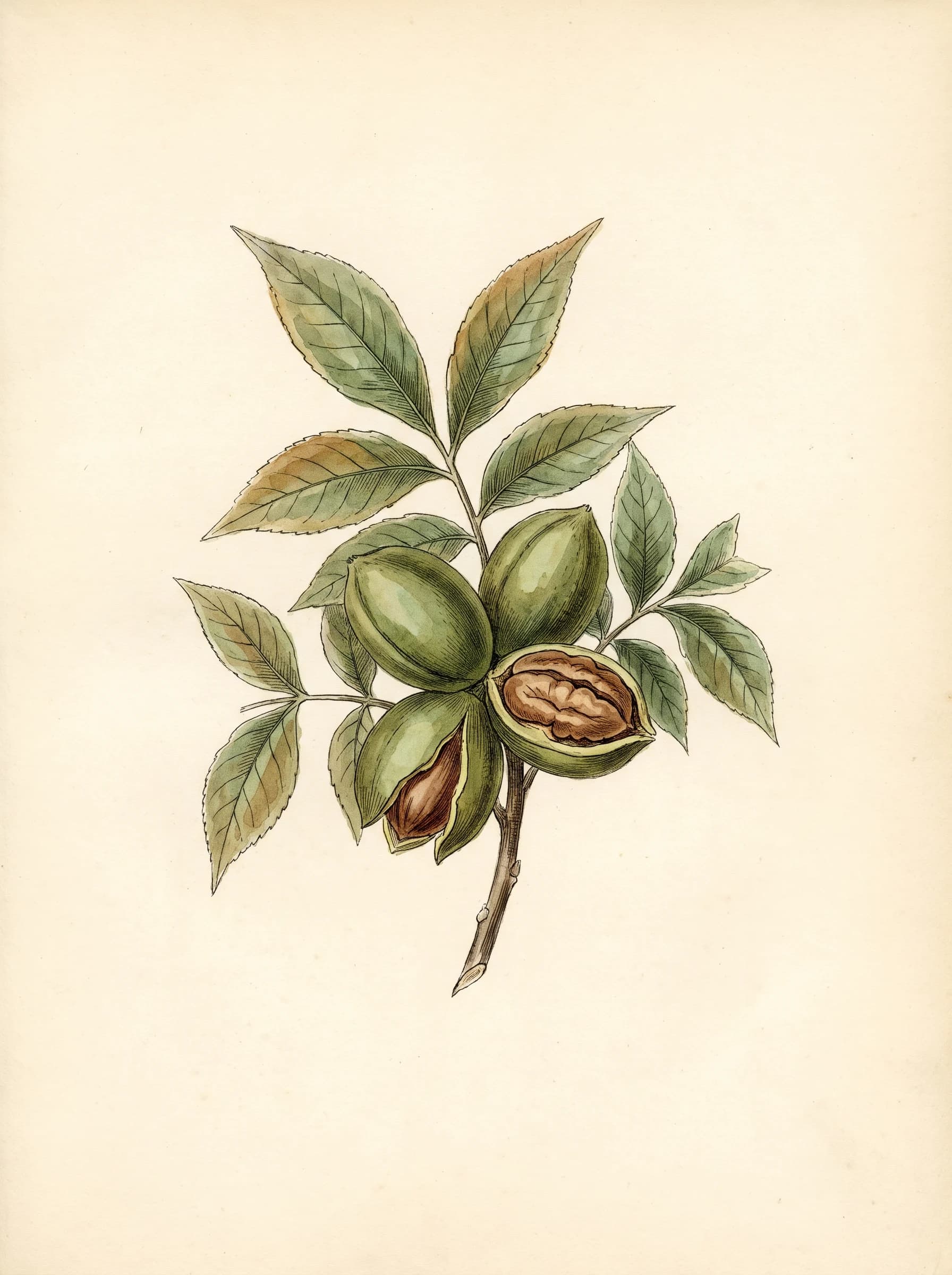
Fruits · nut
Pecan
Delicate in texture and flavor, in W. A. Taylor’s 1904 USDA description of the Centennial pecan.
1 of 5 from sweet (1) to very tart (5). Rated 1 because no source describes acidity; W. A. Taylor’s 1904 USDA description of the Centennial kernel reads “of delicate texture and flavor.”
- Origin
- Native to North America, along the Mississippi River and its tributaries from Iowa to the Gulf of Mexico and in the rivers of Central and East Texas south to Oaxaca, Mexico (New Mexico State University). The first grafted cultivar, Centennial, was propagated at Oak Alley Plantation, St. James Parish, Louisiana, by an enslaved gardener named Antoine: in 1846 according to the National Park Service and NMSU, and in 1846 or 1847 according to W. A. Taylor’s 1904 USDA account.
- Season
- South Georgia: in 2017 growers had begun harvesting Pawnee by late September, with Stuart three to four weeks behind; in the drought year of 2016, Stuart shuck split was still incomplete in November (UGA Extension Pecan Team). Stuart’s shuck split is staggered, so trees are often shaken more than once.
- In the oven
- In the Bexar County Master Gardeners’ recipe notes (Texas A&M AgriLife), pecans placed in the bottom of the crust under the filling “form a crusted layer” as the pie bakes.
The pecan is a hickory native to the river valleys of the Mississippi basin, Texas and Mexico. Grafting by an enslaved gardener named Antoine at Oak Alley Plantation in the 1840s produced the first named cultivar. Texas made the pecan its state tree in 1919 and pecan pie its state pie in 2013.
NMSU’s pecan program notes that Native Americans used pecans for centuries and that early European settlers traded them. Because seedlings do not come true to type, pecans were not developed as a crop until grafting techniques spread in the late 1800s and early 1900s. Pecan South Magazine reprints W. A. Taylor’s 1904 USDA account: Dr. A. E. Colomb took scions from a large tree on the Anita plantation to Oak Alley, where the gardener Antoine grafted sixteen trees in the winter of 1846–47. Nuts from those trees won a diploma at the 1876 Centennial Exposition in Philadelphia, and the cultivar was later catalogued as Centennial.
The National Park Service calls Antoine an enslaved Creole gardener. Taylor called Centennial the first pecan cultivar propagated by grafting and the first planted in a commercial orchard. NMSU records more than 1,000 recognized cultivars today, most of them chance seedlings, and a USDA breeding program at Brownwood, Texas, whose first release, Barton, came in 1953. In Georgia, harvest follows shuck split, early cultivars first and Stuart last; the UGA Extension pecan team notes that Stuart trees often must be shaken more than once.
The 2013 legislative resolution says pecans are native to 152 Texas counties and that Texas growers account for more than 20 percent of the pecans grown in the United States. NASS figures put Texas at 40.3 million of 266.2 million pounds of utilized production in 2021, about 15 percent, and at 24.0 million of 271.5 million in 2023, about 9 percent. Texas A&M AgriLife’s Williamson County office says pecans are native to more than 150 of the state’s 254 counties. Texas designated the pecan the state tree in 1919. Senate Concurrent Resolution 12, adopted by the Senate on March 13, 2013, and by the House on May 17, 2013, designated pecan pie the official State Pie of Texas.
Sources
- Pecan History and Breeding, Pecan Toolbox, New Mexico State University
- Pecan Tree, National Park Service
- The Beginning of Modern Pecan Culture, Pecan South Magazine (quoting W. A. Taylor, USDA Yearbook, 1904)
- Senate Concurrent Resolution 12, 83rd Texas Legislature (2013)
- Pecan Trees, Texas A&M AgriLife Extension, Williamson County (2019)
- January Lunch and Learn, Bexar County Master Gardeners (Texas A&M AgriLife Extension program, 2023)
- Harvest Season Update (Lenny Wells, UGA Extension Pecan Team, 2017)
- Will Stuart Nuts Open? (UGA Extension Pecan Team, 2016)
- Pecan Production (January 2024), USDA NASS