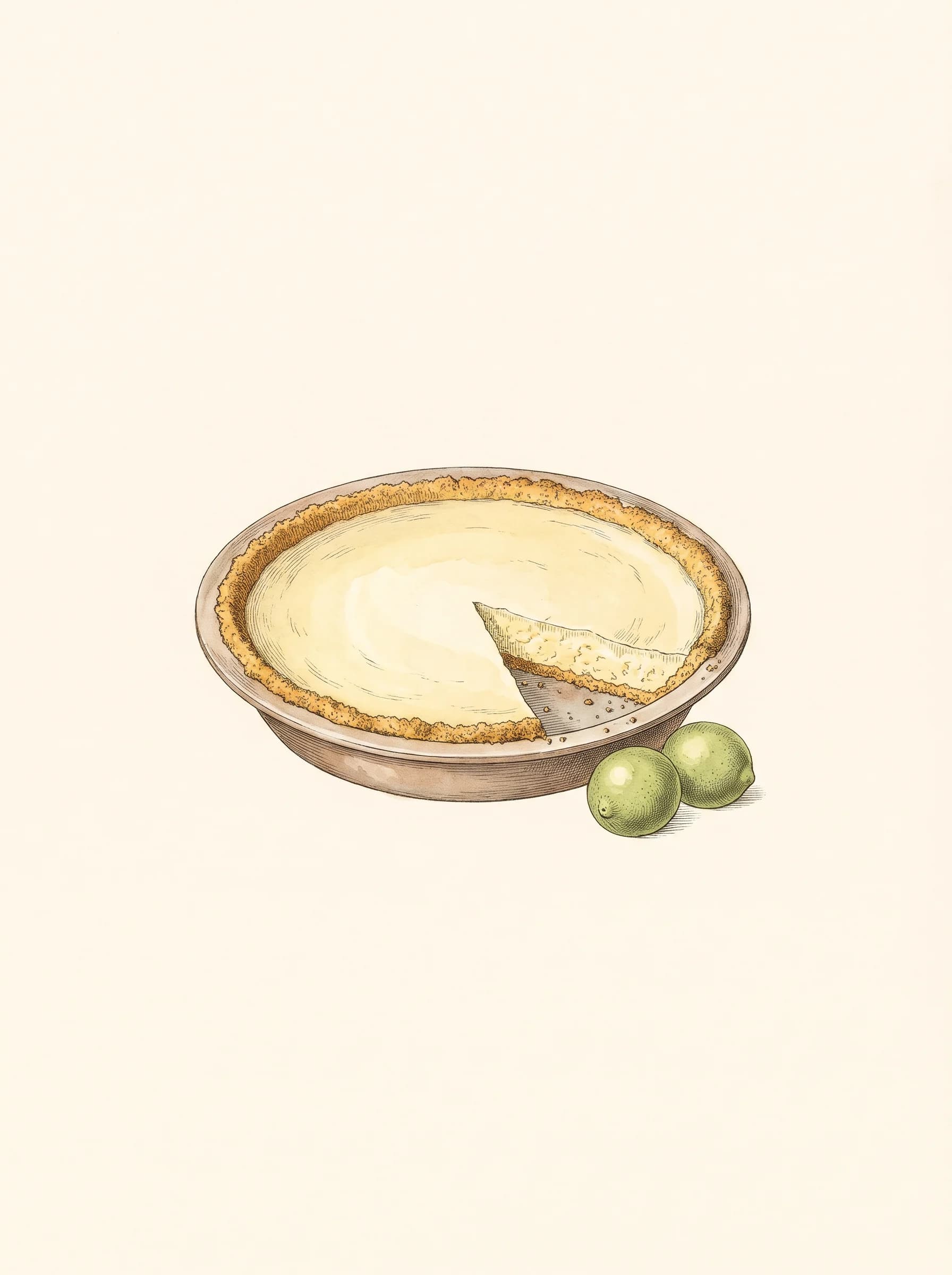
Key lime pie is a chilled custard of Key lime juice, sweetened condensed milk and egg yolks in a crust. Florida named it the official state pie in 2006. Where the pie was first made is disputed: Key West tradition places it in the nineteenth-century Keys, and a rival account traces it to a 1931 condensed-milk promotion.
The filling has three ingredients: Key lime juice, sweetened condensed milk and egg yolks. Key limes are smaller and more aromatic than the common Persian lime, and their juice is yellow, so the filling is pale yellow. The crust is usually graham cracker, though America’s Test Kitchen reports that many Floridians defend a traditional pastry crust, and the Christian Science Monitor noted in 2000 that the pie is sometimes served in pastry. The top may be left plain, finished with meringue or covered with whipped cream.
Recipes differ on whether the pie is baked. The acid in Key lime juice thickens sweetened condensed milk, and WFAE’s no-bake version, made without eggs, is poured into the crust and chilled. Eagle Brand’s published recipe whisks in egg yolks and bakes the pie for 20 minutes at 350°F before chilling it. WFAE notes that many recipes that use eggs require baking.
Two origin stories compete. Key West tradition, voiced by David Sloan, author of The Key West Key Lime Pie Cookbook, holds that sponge fishermen mixed condensed milk, eggs and lime juice at sea, and that a cook known as Aunt Sally perfected the pie in late nineteenth-century Key West. Sloan cites local newspaper articles from 1926. The pastry chef Stella Parks, in her book BraveTart, argues that the Borden milk company created the recipe in 1931 to sell sweetened condensed milk.
Wikipedia’s survey of the printed record begins with Borden’s 1931 “Magic Lemon Cream Pie,” made with condensed milk, lemon and egg yolks under meringue. A “Tropical Lime Chiffon Pie” using condensed milk and yolks appeared in a Miami newspaper in 1933. An “icebox lime pie” was described as a Keys specialty in 1935, and a recipe titled Key lime pie was published in 1940. A 1926 restaurant menu lists a “lime pie” whose contents are unknown. The oldest version of the Aunt Sally story it records dates to 1995, in promotional material for a bed and breakfast in William Curry’s former house in Key West. The food writer John Egerton dated the pie in the Keys to at least the 1890s.
Other sources give other dates. The Florida Senate’s 2006 staff analysis of the state pie bill stated that the first Key lime pie was created in the 1850s in south Florida. The food historian Meryle Evans told the Christian Science Monitor in 2000 that the pie came out of a 1930s Borden campaign for condensed milk and that the earliest Florida recipe appeared in a Key West Women’s Club cookbook in 1939.
Section 15.052 of the Florida Statutes reads in full that Key lime pie “is designated as the official Florida state pie.” It was enacted as chapter 2006-236. A 2018 Canadian Press report described the 2006 vote as naming the state’s official dessert; the statute itself uses the word pie. Florida is the only state assigned to this style, on the strength of that statute.
UF/IFAS Extension records small commercial Key lime plantings in the Florida Keys from about 1913 to 1926 and in Miami-Dade County from the 1970s to the early 2000s, and little to no commercial Key lime production in Florida today. It names Mexico as the largest producer in the Western Hemisphere. Bottled Key lime juice is sold year-round; the Christian Science Monitor wrote in 2000 that it lacks the snap of fresh juice.
Sources
- Florida Statutes s. 15.052, Official state pie (ch. 2006-236), The Florida Legislature
- Food experts debate origin of Key lime pie, The Canadian Press via CFJC Today (2018)
- Key lime pie, Wikipedia
- Super Quick Key Lime Pie, Eagle Brand
- Key Lime Growing in the Florida Home Landscape (Jonathan H. Crane, UF/IFAS Extension, EDIS FC47)
- Florida Senate Agriculture Committee, Senate Staff Analysis and Economic Impact Statement, SB 676, 6 March 2006
- “Go tropical with Key limes,” Christian Science Monitor, 23 February 2000
- WFAEats: The Secret And Science Of Perfect Key Lime Pie (Amy Rogers, WFAE, 2018)
- Morgan Bolling, “Can You Make Key Lime Pie Without Key Limes?,” America’s Test Kitchen, 31 July 2024