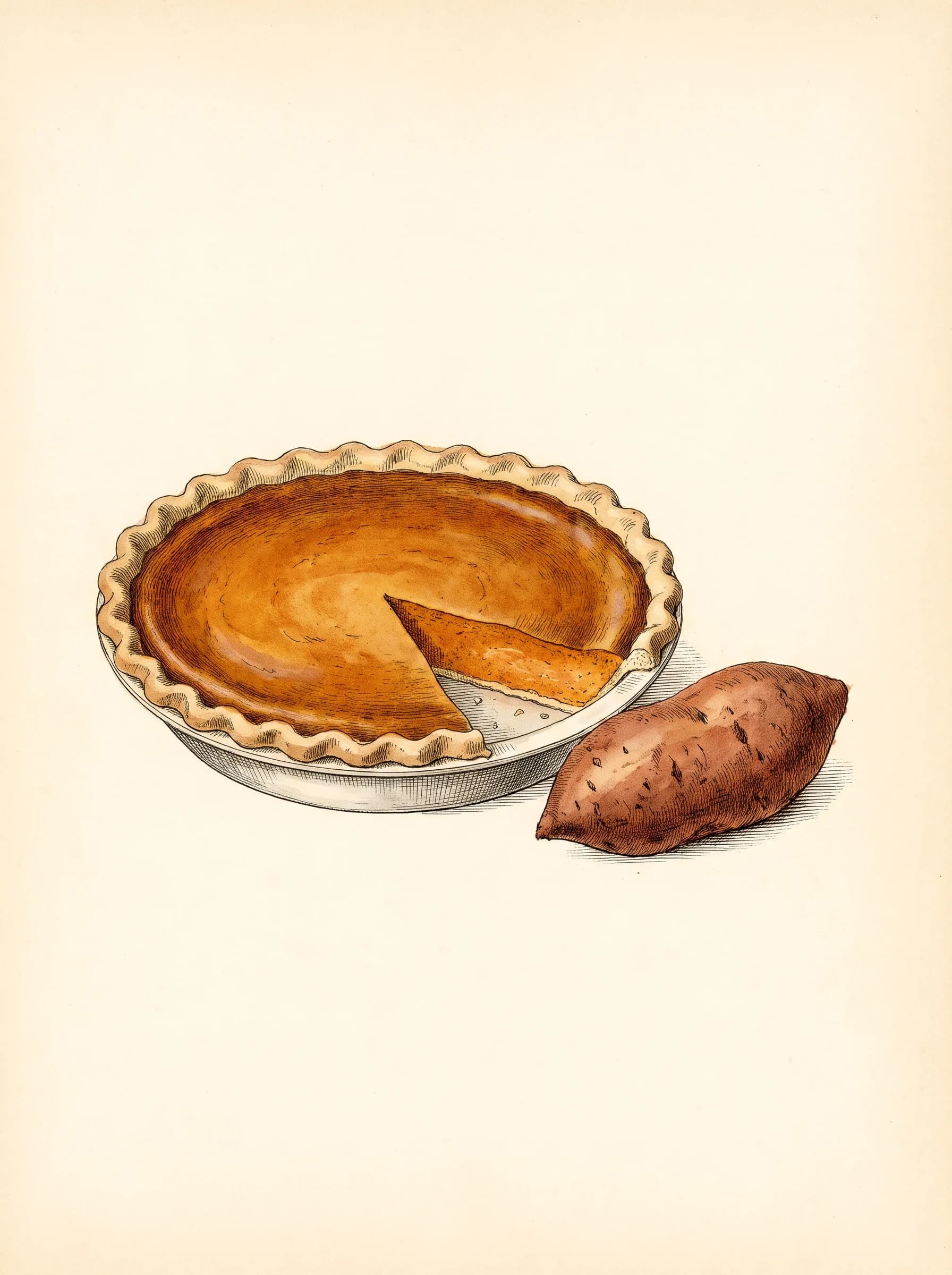
Sweet potato pie is an open-faced custard of mashed sweet potatoes, eggs, milk, butter, sugar and spice. It is a pie of the South and a touchstone of African American cooking, especially at Thanksgiving. An early printed recipe comes from Abby Fisher, a formerly enslaved cook from Mobile, Alabama, whose 1881 cookbook is among the earliest by an African American author.
Boiled or baked sweet potatoes are mashed and mixed with eggs, milk, butter, sugar and spices such as nutmeg and cinnamon, then baked in a single open crust. The filling ranges from light and silky to dense, depending on the ratio of potato to milk and eggs.
The soul food historian Adrian Miller told St. Louis Public Radio that early settlers may have used the sweet potato in place of carrots in European carrot pie, and that recipes with layered slices of sweet potato appear in the historical record. Enslaved Africans learned to cook the sweet potato, which resembles the yams of West Africa. Miller credits the pie’s acceptance to “the expertise of these enslaved cooks,” working in a form that came from European cooking. Wikipedia notes that eighteenth-century cookbooks classed sweet potato pie with savory vegetable dishes and that it became a dessert in the nineteenth century.
Abby Fisher, a former slave who had moved from Mobile to San Francisco, dictated What Mrs. Fisher Knows About Old Southern Cooking in 1881. She could not read or write, signed herself “late of Mobile, Ala.,” and had won a diploma at the Sacramento State Fair in 1879 and two medals at the San Francisco Mechanics’ Institute Fair in 1880. Her sweet potato pie is seasoned with orange juice and grated peel and baked with only a bottom crust. Housekeeping in Old Virginia (1879) prints a richer version with brandy or whiskey, also baked without a top crust.
St. Louis Public Radio describes the pie as a significant touchstone of African American culture, especially around Thanksgiving. When the Sweet Home Café at the Smithsonian’s National Museum of African American History and Culture opened in 2016, it added ginger to its sweet potato pie, and NPR reported that customers used to traditional Southern preparations objected.
North Carolina, Mississippi and Louisiana are assigned to this style. North Carolina adopted the sweet potato as its state vegetable in 1995 (G.S. 145-17) and grew 15.2 million of the nation’s 25.1 million hundredweight in 2023. Mississippi grew 3.84 million hundredweight that year. Louisiana adopted the sweet potato as its state vegetable in 2003 (R.S. 49:170.11); it does not appear among the states in NASS’s 2023 estimates. California, the second-largest producer at 6.08 million hundredweight, has no sourced tie to the pie and remains unassigned.
Sources
- Abby Fisher, What Mrs. Fisher Knows About Old Southern Cooking (San Francisco, 1881), Internet Archive
- What Mrs. Fisher Knows About Old Southern Cooking, Wikipedia
- Marion Cabell Tyree, ed., Housekeeping in Old Virginia (1879), Project Gutenberg
- Pumpkin or sweet potato pie? There’s a rich history behind both, Georgia Public Broadcasting / St. Louis Public Radio (2023)
- Don’t Mess With The Sweet Potato Pie: A Museum Wrestles With ‘Authentic’ Black Menu, NPR The Salt (2018)
- N.C. Gen. Stat. Chapter 145, State Symbols, § 145-17 State vegetable, North Carolina General Assembly
- La. R.S. 49:170.11, State vegetable plant; state vegetable, Louisiana State Legislature
- Mississippi Sweet Potato Summary (2023 data), USDA NASS (2024)
- Sweet potato pie, Wikipedia
- Pumpkin pie, Wikipedia
- George W. Carver, How the Farmer Can Save His Sweet Potatoes and Ways of Preparing It for the Table, Tuskegee Bulletin No. 38 (copy dated February 2, 1922), Internet Archive
- George W. Carver, How the Farmer Can Save His Sweet Potatoes and Ways of Preparing Them for the Table, Tuskegee Bulletin No. 38, third edition (November 1935), Internet Archive