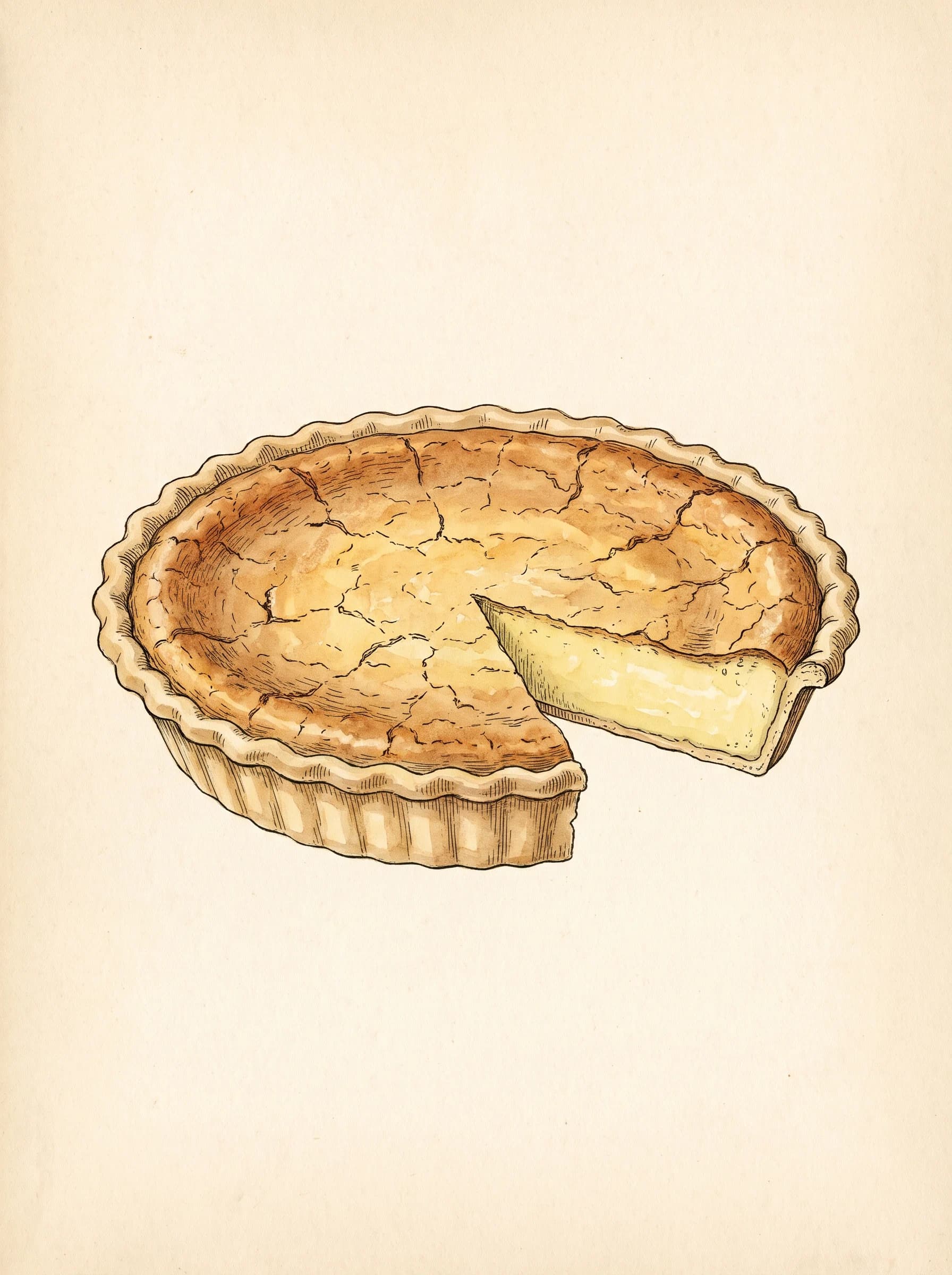
Chess pie is a single-crust pie of butter, sugar and eggs, sometimes with flour, cornmeal, milk, vinegar or lemon. It is identified with the American South, where nineteenth-century church cookbooks printed it as chess cake. No one knows where the name came from.
The basic filling is butter, sugar and eggs, baked in one crust. Many recipes add flour or cornmeal as a thickener and an acid such as vinegar, buttermilk or lemon juice. The ingredients keep year round and cost little, and the pie is counted among the desperation pies. Lemon, coconut and chocolate chess pies are common variations.
Upper South church cookbooks of the nineteenth and early twentieth centuries print the dish as chess cake. Housekeeping in the Blue Grass, compiled in 1881 by the Missionary Society of the Southern Presbyterian Church in Paris, Kentucky, gives a Chess Cake from Miss Jennie Macrae of Clarksville, Tennessee: butter, sugar and twelve yolks stirred over hot water, then baked in pastry in small tart pans. How We Cook in Tennessee, published in 1906 by the Silver Thimble Society of the First Baptist Church in Jackson, Tennessee, prints three chess cake recipes. One recipe headed Chess Pie appears in Buckeye Cookery and Practical Housekeeping, in a copy published in Minneapolis and copyrighted in 1877. The book began in Ohio: the Ohio State University Press and The Henry Ford describe it as a fundraising cookbook of the First Congregational Church in Marysville, Ohio, first published in 1876, under the title Centennial Buckeye Cook Book in the Ohio State reprint. The recipe was submitted by Miss J. Carson of Glendale and finishes the pie with a meringue of the whites. The 1877 copy held by Cornell names no state for Glendale; Wikipedia, citing an 1881 edition, places it in Minnesota.
Older English and Virginian dishes are close relatives. Wikipedia cites the food writer Michael Krondl tracing chess pie to the British transparent pudding, and Jean Anderson describing Mary Randolph’s transparent pudding as, for all intents and purposes, chess pie. Housekeeping in Old Virginia (1879) prints transparent pudding under that name. The First Ladies Cook Book (1965) credited a chess cake recipe to Martha Washington, but the recipe in her manuscript is for cheesecakes without cheese curd.
The name has no agreed origin. One theory derives it from cheese, through English chess cake or cheesecake, a link Wikipedia credits to Marion W. Flexner’s 1938 article “In Search of Chess Pie.” Another derives it from the pie chest where pies were kept. A third holds that a cook asked what she was baking answered “it’s jes’ pie.” The date of first use is disputed as well. In 2001 the researcher Barry Popik reported that the Dictionary of American Regional English’s first citation was from 1932 and that John Mariani’s encyclopedia named a 1928 Fort Worth Women’s Club cookbook as the earliest printed reference. Popik himself had found “chess cake” in 1882 and “chess pie” in Mrs. D. A. Lincoln’s Boston Cook Book of 1884. The cookbooks named above are older still.
Kentucky and Tennessee are assigned to this style on the church-cookbook record above. Neither state has designated a state pie in the sources cited. Other Southern states where the pie is also common remain unassigned until a source ties them to it.
Sources
- Housekeeping in the Blue Grass (Missionary Society of the Southern Presbyterian Church, Paris, Ky.; Cincinnati: Robert Clarke, 1881), Internet Archive
- How We Cook in Tennessee (Silver Thimble Society, First Baptist Church, Jackson, Tenn., 1906), Internet Archive
- Estelle Woods Wilcox, Buckeye Cookery and Practical Housekeeping (Minneapolis: Buckeye Publishing Co., copyright 1877), Internet Archive
- Marion Cabell Tyree, ed., Housekeeping in Old Virginia (1879), Project Gutenberg
- Barry Popik, “Chess Pie,” American Dialect Society mailing list ADS-L (2001)
- Chess pie, Wikipedia
- Centennial Buckeye Cook Book, introduction by Andrew F. Smith, The Ohio State University Press
- Buckeye Cookery, The Henry Ford