Fruits · stone fruit
Montmorency
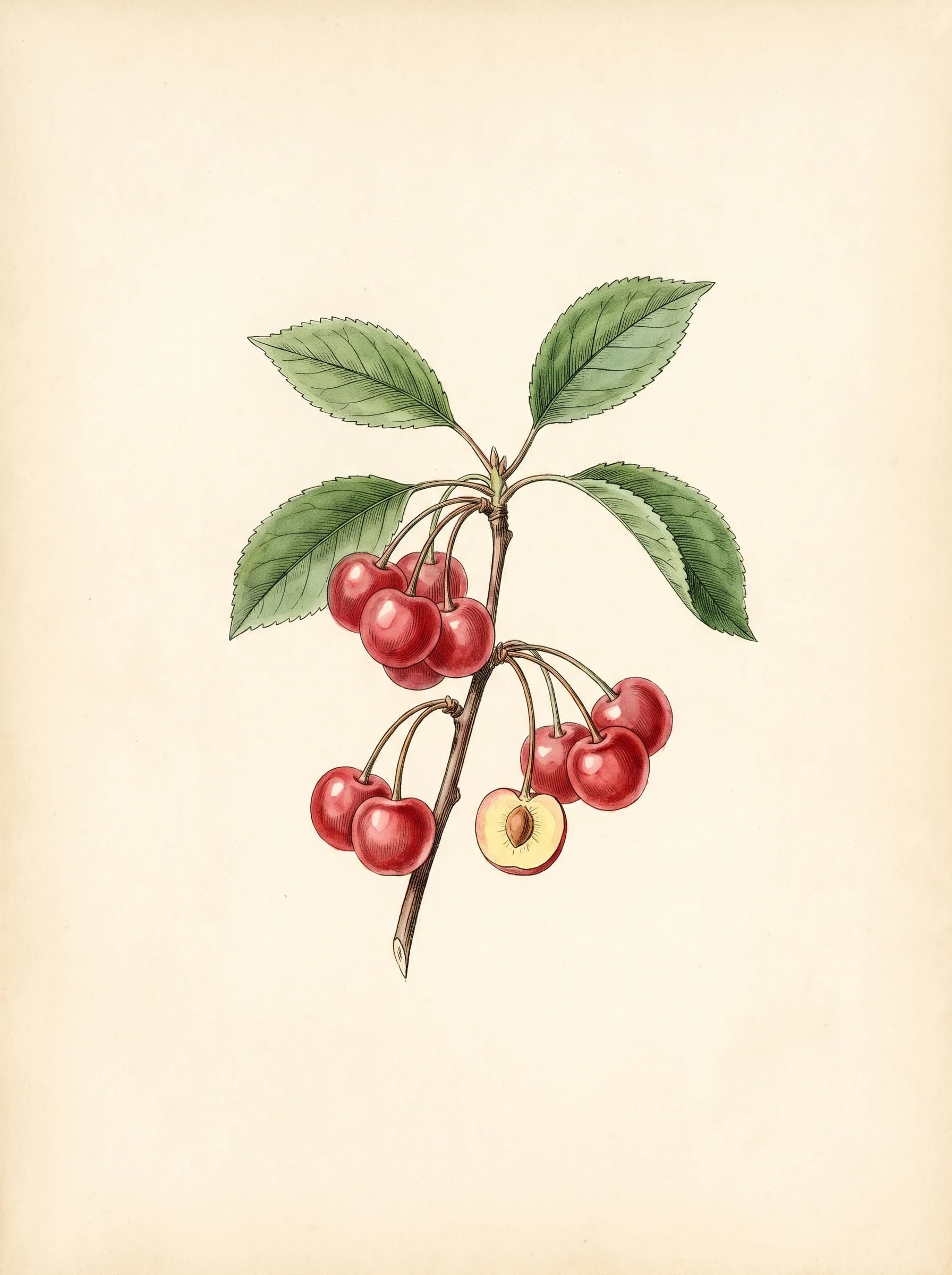
Tart, bright red with yellowish flesh and clear juice, in Good Fruit Grower’s description.
5 of 5 from sweet (1) to very tart (5). Rated from the USDA NASS training material’s description of Montmorency as tart cherries “also known as sour cherries.”
- Origin
- Montmorency, north of Paris, France. The University of Wisconsin’s Uncommon Fruit project says it was selected there more than 400 years ago. Good Fruit Grower (2011) says it is thought to come from the Montmorency Valley, where it was named for a noble family that grew it.
- Season
- Northern Michigan: about mid-July in Traverse City, just after the early sweet cherries (Good Fruit Grower, 2011).
- In the oven
- Juicy, with clear juice and bright color. King Arthur Baking’s thickener guide says fresh cherries need slightly less thickener than canned or frozen. The USDA NASS training material notes that Montmorency cherries keep their bright red color when dried, frozen or juiced, and nearly all tart cherries are processed. Good Fruit Grower describes the fruit as bright red with yellowish flesh and clear juice.
Montmorency is the sour cherry of American cherry pie, a French cultivar that accounts for nearly all tart cherries grown in North America. Michigan grows most of the crop. Almost all of it is processed, frozen, canned or dried.
Good Fruit Grower called Montmorency the cherry synonymous with cherry pie, and noted how little is recorded of its pedigree. It is thought to come from the Montmorency Valley just north of Paris, and the University of Wisconsin’s Uncommon Fruit project dates its selection there to more than 400 years ago. In Europe, Good Fruit Grower adds, tart cherries with dark flesh and juice are preferred.
Montmorency belongs to the Amarelle group of tart cherries, bright red with clear to yellow flesh, as against the dark-juiced Morellos. Sources give its share of the North American tart cherry crop as about 95 percent (Good Fruit Grower, 2011) or “almost all” (USDA NASS). Michigan’s share of United States tart cherry production varies by year and by source: USDA NASS forecast 182 of 222 million pounds for Michigan in 2024, while Cherry Industry Administrative Board data put Michigan at 57 percent in 2025, when frost cut the northwest Michigan crop, against a traditional share of close to 70 percent.
The fruit ripens about mid-July in Traverse City and is processed almost entirely; USDA NASS training material puts processing at 99 percent of the crop and notes that the cherries keep their bright red color when dried, frozen or juiced. King Arthur Baking’s guide notes that fresh cherries need slightly less thickener than canned or frozen ones.
Sources
- Tart cherry of French heritage, Good Fruit Grower (January 15, 2011)
- Tart Cherry (pie cherry, sour cherry), Uncommon Fruit, Center for Integrated Agricultural Systems, University of Wisconsin–Madison
- Michigan Cherry Production forecast, USDA National Agricultural Statistics Service (2024)
- 2026 June Cherry Production Inquiry, Enumerator Training, USDA NASS and NASDA
- U.S. cherry crop falls to 49.4 million kg in 2025, FreshPlaza (citing Cherry Industry Administrative Board data)
- Pie Thickener Guide, King Arthur Baking